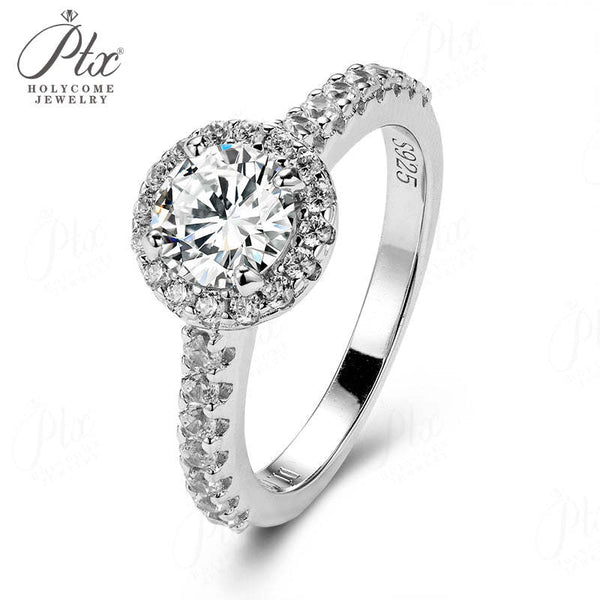
4ct Moissanite Price: Why 531 Variants Sit at $279

Quick Answer
481 variants at 4ct, median $216.00 — the highest carat median in our range, and well above 2ct ($128.61) and 5ct ($123.08).
That is the opposite of what a straight carat index would predict. Here is what puts 4ct at the top.
4ct against the range
| Carat | Variants | Median |
|---|---|---|
| 1ct | 2,120 | $81.89 |
| 2ct | 1,058 | $128.61 |
| 3ct | 795 | $151.96 |
| 4ct | 481 | $216.00 |
| 5ct | 402 | $123.08 |
4ct sits $92.92 above 5ct at the median. Both are large stones. The difference is not the stone.
What puts 4ct on top
Four carats is the size where buyers tend to pair a large stone with real metal. At 5ct many customers accept silver as the sensible compromise; at 4ct the gold proportion in our stock is higher. That pushes the median up.
Four carats is also a common target for engagement-style rings, which carry better settings and heavier bands than statement pendants. A good setting on a 4ct stone needs more metal than the same setting on a 2ct one.
Is 4ct a good buy?
It depends what you are optimising. If price per carat matters most, 5ct at $123.08 beats 4ct at $216.00. If you want a large stone in gold with a proper setting, 4ct is where that combination concentrates — and you pay for the metal, not the extra carat.
The honest read: 4ct is not a value outlier. It is the point where our stock most often pairs size with quality of setting.
What to check on a 4ct piece
- Setting security. A stone this size in a light setting is a risk. Four prongs, minimum.
- Metal confirmation. Confirm the variant is the metal you want, not the default the page opens on.
- Band width. A 4ct stone on a thin band tips. Look for a band proportional to the stone.
The 4ct row is the widest in the table
481 variants, median $216.00, spanning $29.17 to $1,718.58. That is the largest ratio in the carat table, and it reflects how differently 4ct is used: as a single centre stone in gold, and as a total weight across a silver band.
A ratio that wide means the median describes almost nobody. Use it as a midpoint marker, and price the specific piece you are considering.
Why 4ct has the highest median of the common weights
Four carats is above the point where most buyers stop for a solitaire, so the pieces that carry it are either deliberate statement rings or elaborate multi-stone designs. Both are expensive. The result is a median above the 5ct row, which contains more modest total-weight pieces.
This is the clearest example in the catalogue of why "higher carat equals higher price" fails as a rule. Composition beats carat.
Practical considerations
A 4ct single stone in a ring needs a secure, low setting and a band of adequate width. Silver is possible but will show wear sooner under the weight. A prong setting must be checked regularly, because a stone this size coming loose is a real risk.
For pendants and earrings, weight matters differently: a 4ct pendant hangs and moves, which distributes perceived weight, while a 4ct earring pulls on the piercing and needs a substantial backing.
Where to spend and where to save
Save on: the metal if the piece is occasional wear. Spend on: the setting security. A 4ct stone in a cheap setting is the worst value in jewellery, because losing it costs more than the setting upgrade would have.
If you are comparing two 4ct quotes, ask about the setting before the metal. The cheaper quote is usually the thinner gallery and fewer prongs, and that is the number that determines whether the stone survives.
Four carats is where design intent shows
481 variants, median $216.00, range $29.17 to $1,718.58. The ratio here is the widest in the table, and the reason is intent: a 4ct piece is either a deliberate statement or a total-weight design, and those two are not close in price.
When a supplier quotes a 4ct price without saying which, the number is not comparable to anything.
Metal weight becomes the dominant cost
Above 3ct the setting has to be built around the stone rather than the stone fitted into a standard head. That means more metal in the gallery, a wider band, and often a heavier shank. At this point the gold cost can exceed the stone cost.
Ask for grams. A 4ct ring in gold with a substantial gallery may use several grams more metal than a solitaire of the same carat in a light setting, and that difference is most of the price gap.
Buying four carats well
Prioritise the setting over the stone. A slightly smaller stone in a secure, well-proportioned setting will outlast and out-look a larger stone in a light one. Check the prong thickness, the gallery depth and the band width — three things that cost money and that cheap pieces skimp on.
Then confirm the stone's dimensions in millimetres. At this size the spread matters: a shallow 4ct can face up smaller than a well-cut 3.5ct.

FAQ
Why is 4ct the most expensive carat median?
Because our 4ct stock pairs large stones with better settings and more gold than the 5ct group does. The median reflects the metal mix.
Is 4ct better than 5ct?
Neither is better. 5ct gives more size per dollar ($123.08 median); 4ct gives more metal and setting quality per dollar ($216.00 median).
How many 4ct variants do you carry?
481, ranging $29.17 to $1,718.58.
Should a 4ct stone be certified?
For moissanite, certification is less standard than for diamond. Ask what documentation comes with the piece rather than assuming a grading report.
Does 4ct work in a pendant?
Yes, and it is a common format — a large single stone on a chain. Expect the pendant to carry the visual weight rather than blend with an outfit.