Does Moissanite Cloud or Fade? What Actually Happens Over Time

Moissanite does not cloud. It gets dirty. Those are different problems with different outcomes. This article covers what actually causes a moissanite to look dull, why it is almost always reversible, and the two situations where it genuinely is not.
The short answer
Moissanite is silicon carbide, a chemically inert material. It does not absorb oils into its structure, does not yellow with UV exposure, and does not degrade with age. A moissanite that looks flat after a year is almost always coated in a film of soap, skin oil, hand cream or hair product on the underside — the pavilion, where light enters and exits.
Clean it properly and the brightness comes back completely. Unlike cubic zirconia, which genuinely clouds from the inside, moissanite does not reach a point of no return.
Why the underside matters more than the top
Light enters a stone through the top (table), bounces around inside, and exits. Most of the light that creates brilliance reflects off the bottom facets and passes back out through the top. If the bottom is coated in oil, the light that would have reflected leaks out sideways instead, and the stone reads dull — even though the top surface looks clean.
This is why rings always look worse than pendants. A ring sits in contact with skin, soap, hand cream, dishwater and food, and its underside is the part nobody looks at. A ring that "lost its sparkle" usually has a completely clean top and a filthy bottom.
What actually makes it dull, in order of likelihood
- Skin oil and soap residue — the most common by a wide margin. Builds up invisibly over weeks.
- Hand cream, sunscreen, hairspray — these leave a tacky film that traps dust.
- Hard water and limescale — leaves a whitish deposit in the pavilion, especially in areas with mineral-heavy water.
- Chlorine and cleaning products — not damaging to the stone, but they degrade the metal setting and rhodium plating around it.
- Physical abrasion of the metal setting — the prongs wear, and wear makes the stone sit differently.
Note what is not on this list: the stone itself. In normal wear, moissanite does not change.
The cleaning method that works
Ten minutes, no equipment:
- Warm water with a drop of dish soap. Not hot — warm. Hot water plus cold stone can stress a setting.
- Soak for five to ten minutes to soften the film.
- Brush the underside with a soft toothbrush. This is the step that actually matters. Get into the pavilion, under the prongs, into the gallery rail.
- Rinse under running water with the drain plugged. Loose stones are the most common jewellery casualty; nobody plans to lose one.
- Dry with a lint-free cloth, then let it air dry fully before wearing.
Do this once a week for a ring worn daily. It takes less time than making coffee and it is the entire difference between a stone that sparkles and one that does not.
What to avoid
- Ultrasonic cleaners — generally fine for moissanite itself, but they can loosen prongs over time and are risky on glued settings or pieces with small accent stones. If in doubt, skip it.
- Steam cleaners — same concern about the setting, not the stone.
- Toothpaste — mildly abrasive. It will scratch rhodium plating and, over many uses, dull the metal.
- Bleach and chlorine — do not damage the stone, but they attack the alloy in the setting and degrade plating. Take rings off before cleaning the bathroom or swimming in chlorinated pools.
- Boiling water — thermal shock can crack a stone that has an inclusion, and can loosen settings.
The two situations where it really is permanent
1. Physical damage to the surface. If a moissanite has been worn against another diamond in a shared jewellery box, or scraped hard against a rough surface, it can pick up fine surface abrasion. Those scratches scatter light and cannot be washed away. A jeweller can repolish the stone, but it is a professional job.
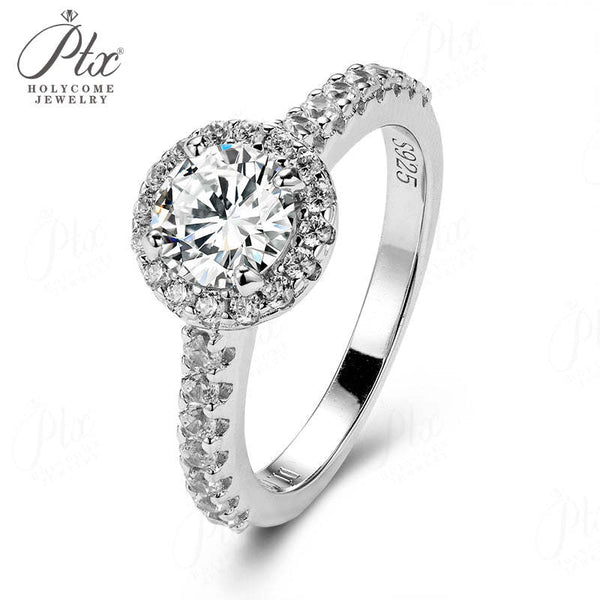
2. Plating wear, not stone wear. If the piece is rhodium-plated 925 silver, the plating wears through in six months to three years depending on wear, and the metal underneath shows a warmer, duller tone. The stone is still bright; the metal around it has changed. This is normal, it is not a defect, and re-plating is routine — see below.
Rhodium plating: the thing that actually ages
Most white-looking silver jewellery is 925 sterling silver plated with rhodium, a platinum-group metal that gives the bright white finish. Rhodium is hard but thin — typically well under a micron — and it wears off where the ring contacts skin and other objects.
Signs it is due for re-plating: the piece looks slightly yellow or grey in the areas that touch skin, and it no longer matches a new piece of the same design. Re-plating is standard maintenance, takes a day at most jewellers, and costs little. With daily wear, plan on every one to three years.
Solid gold — 9K, 14K and 18K — does not need this. It holds its colour all the way through, because the colour is the metal, not a coating. This is the main practical argument for solid gold over plated silver if you plan to wear the piece daily for a decade.
Storage that prevents most of the problem
Store pieces dry, separately, and closed. Airtight is better than open. Three rules cover almost everything:
- Not in the bathroom. Humidity is the enemy of silver and the friend of tarnish.
- Not loose together. Stones in contact with each other abrade. Use a compartment or a soft pouch per piece.
- Not in direct sunlight on a windowsill. UV is harmless to moissanite but degrades some setting adhesives and finishes.
Silver also tarnishes — not the stone, the metal — and a silver polishing cloth once a month keeps that in check. Tarnish is a surface layer, fully removable, not a permanent change.
If your stone looks dull right now
Before assuming anything is wrong: warm water, dish soap, soft brush on the underside, ten minutes. In the large majority of cases the piece comes back completely.
If it does not, the likely causes in order are plating wear on the metal, surface abrasion on the stone, or a setting that has shifted and is no longer holding the stone at the right angle. All three are things a jeweller can look at in person and none of them mean the stone is finished.
Every piece we ship comes with the care instructions for its specific metal, and we will tell you honestly what metal a piece is made of — solid 9K, 14K, 18K gold, or rhodium-plated 925 silver — because that determines how much maintenance it will need over its life.