Can You Tell Moissanite From Diamond? The Tests That Actually Work

Most people cannot tell. Jewellers can, with a loupe and thirty seconds. This is the honest answer, and it is more useful than either "nobody can tell" or "it's obvious". Here is exactly what gives a moissanite away, at what distance, and to whom.
The three-second test anyone can do
Hold the stone so you are looking down through the table (the flat top), with a light behind it. Look at the facet edges on the far side of the stone, visible through the table.
In a diamond, those edges are single, sharp lines. In a moissanite — especially above 1.5 carats, and most visibly in step cuts — the edges appear doubled, like a faint ghost line alongside each one. This is double refraction: moissanite splits light into two paths, so every edge is imaged twice.
That is the single most reliable visual tell, and it needs no equipment. It is much harder to see in brilliant cuts (round, oval, radiant), where the facet pattern is busy enough to mask it, and much easier in emerald and asscher cuts where the facets are large and flat.
Why the fire looks different
Moissanite throws more coloured flashes than diamond. Under warm indoor light — candlelight, restaurant lighting, incandescent — the difference is noticeable once you know to look for it. Diamond fire is present but restrained; moissanite fire is louder and more rainbow-like, sometimes described as "disco" by people who do not like it.
This cuts both ways. Some buyers prefer the extra fire, some find it a giveaway. Either way it is a character difference, not a quality problem. If you want a stone that behaves quietly like a diamond, moissanite will feel slightly too lively.
What a jeweller checks
A jeweller uses instruments, in this order:
- Loupe, 10x — the doubling test above, at close range. Most reliable with the naked eye.
- Refractometer — measures refractive index. Diamond reads 2.42; moissanite reads 2.65 to 2.69. This is definitive and takes seconds.
- Microscope — moissanite has characteristic growth patterns and, in some stones, tiny needle-like inclusions that do not occur in diamond.
The one test that does not work
Thermal conductivity testers — the "diamond tester" pens sold online and used in many shops — cannot reliably separate moissanite from diamond. Both conduct heat similarly, so a basic pen will read "diamond" on a moissanite. This is why some moissanite sellers advertise that their stones "pass the diamond tester": it is true, and it is also meaningless as proof.
If someone uses a pen as their entire verification, they are not verifying anything. A refractometer is the instrument that settles it.
At what distance does it matter
Practically:
- Across a room — nobody can tell. Both stones sparkle, both are colourless.
- Across a table — almost nobody can tell. Someone who works in jewellery might notice the fire is a little stronger than expected.
- Holding your hand, looking closely — a jeweller or an experienced buyer can see the doubling in under a minute if the cut is a step cut.
- Under a loupe — obvious to anyone who knows what a single facet edge should look like.
So the realistic answer is: it is not detectable in social situations, and it is detectable in a professional setting. If your concern is being "caught", that concern is misplaced. If your concern is honesty — telling the recipient what the stone is — that is a different question and it has a simple answer: tell them.
Where the two stones genuinely differ in wear
Beyond looks, two practical differences show up over years:
- Hardness — diamond 10, moissanite 9.25. Both resist scratching in daily wear. Moissanite is not a fragile stone; it is simply not diamond-hard. Both will scratch if stored loose against each other.
- Toughness — moissanite is slightly more prone to chipping at the girdle than diamond if struck hard, which is why a well-made setting with protected prongs matters more than the stone choice for most rings.
What this means for buying
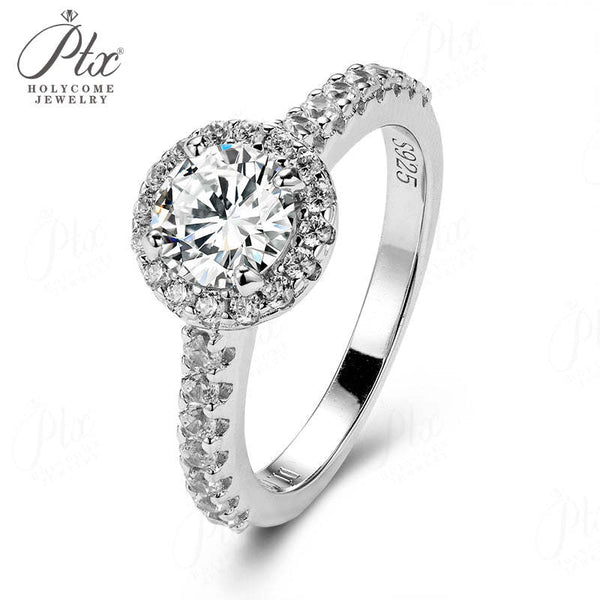
If you are buying moissanite and want it to read as diamond-like: choose a brilliant cut (round, oval, radiant) rather than a step cut, keep it under 2 carats where the doubling is subtle, and pick a setting that covers the girdle.
If you are buying and want to be certain what you received: ask for the certificate number and check it against the lab's own lookup. GRA certificates cover moissanite and state the stone type explicitly. IGI certificates cover lab grown diamond and state the growth method. A certificate that does not name the stone type is not a certificate worth having.
Every moissanite piece we ship carries a GRA certificate matched to that specific stone, packed in the box. Lab grown diamond pieces carry IGI. If you want the certificate number before you order, ask and we will send it.