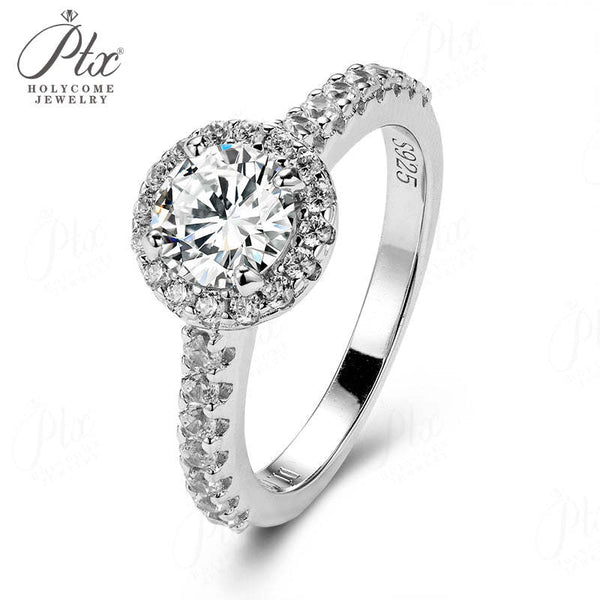
5ct Moissanite: 452 Variants, $123 Median Explained

Quick Answer
402 variants at 5ct, median $123.08, ranging $32.61 to $1,794.80.
A five-carat moissanite at a median of $123.08 is one of the strongest value positions in our catalogue. It is also the figure most likely to confuse a buyer who assumes carat and price rise together.
The 5ct numbers against its neighbours
| Carat | Variants | Median |
|---|---|---|
| 2ct | 1,058 | $128.61 |
| 4ct | 481 | $216.00 |
| 5ct | 402 | $123.08 |
| 6ct | 115 | $125.99 |
5ct medians below 4ct by $92.92. Same explanation as everywhere in this cluster: the metal mix differs, and the median reflects it.
Why 5ct concentrates in silver
A five-carat stone is a statement. The buyers who want one usually want maximum size for a defined budget, which pushes them toward the cheapest metal that still looks good. Silver fills that role.
That is a deliberate product decision reflected in our stock: 402 five-carat variants, many of them silver solitaires and statements where the stone is the entire visual argument.
What five carats looks like
It is a genuinely large stone — the kind that reads at a distance. On a ring it will sit high and attract comment. On a pendant or in a pair of studs it dominates.
Wearability changes at this size. A 5ct stone catches on knitwear, sits above the finger and needs a solid setting. If you want something you forget you are wearing, this is not it.
The gold end of 5ct
The maximum 5ct variant is $1,794.80. That is a gold piece, and it shows what happens when you combine a large stone with heavy metal — the two premiums compound rather than add.
Nothing wrong with that if it is what you want. Just know the $123.08 median is a silver figure, and the gold top of the range is a different product entirely.
Five carats, and why the sample is thin
402 variants carry a 5ct figure, median $123.08, from $32.61 to $1,794.80. Compared with the 1ct row at 2,120 variants, this is a small sample — and it is also the row where the "total weight versus centre stone" ambiguity is most common.
At 5ct, a single stone is genuinely large. Most 5ct listings in our catalogue are multi-stone pieces where 5ct is the sum across the setting, not one enormous stone. Read the listing description, not the number alone.
Why a 5ct median can be lower than 2ct
The 5ct median of $123.08 sits below the 2ct median of $128.61. That inverts the intuition that more carat costs more, and the explanation is composition: the 5ct bucket contains many small-stone pieces totalling five carats in silver, while the 2ct bucket contains single-stone pieces in heavier settings.
This is a statistical artefact of pooling unlike products, not a pricing anomaly. It is also exactly the kind of thing that makes category medians unreliable for individual decisions — and the reason we print sample sizes next to every number.
Is a 5ct stone wearable?
A single 5ct stone is a statement piece, not an everyday ring. Consider: the stone sits high, the ring will feel top-heavy, and it will catch on sleeves and hair. For occasional wear that is fine. For daily wear most buyers prefer to stay at 2ct or below.
If the 5ct is total weight across a band or halo, the piece wears normally — the weight is distributed and the profile is low. This is why total-weight pieces are popular for buyers who want presence without a giant central stone.
Cost drivers at this level
Metal, again. A large single stone needs a substantial head and a wider band, and both are metal. The setting labour is comparable to a smaller solitaire; the metal is not. If you are pricing a 5ct piece, ask for the metal weight in grams — at this size it is a significant share of the total.
Why the five-carat bucket behaves oddly
At 402 variants the 5ct row is thin enough that composition dominates. Our 5ct stock includes a large share of multi-stone pieces where the figure is total weight, and those are cheaper than a single large stone in gold. The result is a median of $123.08 sitting below the 2ct median.
This is a genuine artefact, not an error, and it is the clearest illustration in the catalogue of why category medians cannot be used as quotes.
Total weight pieces at five carats
Five carats spread across a tennis bracelet is roughly half a carat per stone over ten stones, or a dense line of smaller stones. Spread across a necklace, more stones still. Both formats wear comfortably and look expensive, because the sparkle is distributed rather than concentrated.
That is the format most buyers actually want when they say they want "five carats". Very few want a single stone that size.
What to verify in a 5ct listing
- Centre stone weight versus total weight.
- Number of stones, if it is a multi-stone piece.
- Metal and its weight in grams.
- Clasp or finding type, for bracelets and necklaces.
Four questions, and any listing that cannot answer them is not giving you enough to compare.

FAQ
How much is a 5ct moissanite?
Median $123.08 across 402 variants, from $32.61 to $1,794.80.
Why is 5ct cheaper than 2ct?
Our 5ct stock leans heavily into silver statement pieces; the 2ct group carries more gold work. Metal mix sets the median, not carat.
Is 5ct practical for everyday wear?
It is large and sits high. Fine for occasional or statement wear; less comfortable for constant use.
Can I get 5ct in 14K or 18K?
Some variants reach $1,794.80, which is gold work. Check the product page variant selector.
Does a 5ct moissanite look fake?
Size is the giveaway people notice, not the stone. A 5ct moissanite reads as a large stone, which some interpret as costume. That is a perception question, not a quality one.