Bigger Stone or Better Cut? The Data Says

Quick answer: In our own catalogue, going from a 1ct stone to a 3ct stone raises the price by $4.54, or 4.6%. Going from 925 silver to 14K gold raises it by $86.35, or 88.9%. Size is the cheapest thing you can change and the metal is the dearest. That inverts the usual instinct: if you have budget to place, put it into the cut and the setting first, and treat carat weight as nearly free.
The carat ladder from our own 708 listings, the one step where it breaks, and where the money actually goes.
The claim being tested
The received wisdom is that bigger stones cost more, so a budget buys either size or quality. That is true of diamonds, where the polished trade prices carat weight steeply. It is not true of manufactured stones, and the reason is simple: moissanite is grown, not mined, so a larger stone does not require a rarer accident of nature. It requires a larger growth run and a longer cut.
Both of those cost something. Neither costs what the market assumes.
The carat ladder in our own numbers
| Centre stone | Median piece price | Price per carat | Cost of the step up |
| 0.5ct | $88.46 | $176.92 | — |
| 1ct | $99.18 | $99.18 | +$10.72 (12.1%) |
| 2ct | $103.23 | $51.62 | +$4.05 (4.1%) |
| 3ct | $103.72 | $34.57 | +$0.49 (0.5%) |
| 4ct | $183.50 | $45.88 | +$79.78 (76.9%) |
Read the fourth column. Doubling from 1ct to 2ct costs $4.05. Going from 2ct to 3ct costs forty-nine cents. The price per carat falls from $176.92 at half a carat to $34.57 at three, which is the opposite of how diamonds behave and the single most useful fact in this article.
One honest caveat: these are medians across pieces, not a controlled experiment. A 3ct piece is more often a pendant and a 0.5ct piece more often a pair of studs, so some of the flatness is mix rather than material. The direction is robust; the exact cents are not.
Why 4ct breaks the pattern
At 4ct the median jumps 76.9% to $183.50. This is not a pricing trick but a yield problem: a 4ct stone needs a great deal more rough, fewer large stones come out of each growth run, and a stone that size is cut and polished on its own rather than in a batch. Big stones stop being a commodity at exactly the point where the raw material stops being one.
The practical reading: 1ct to 3ct is nearly free, 3ct to 4ct is the first real decision. If 3ct is enough, you never meet the expensive step.
What a cut actually costs
Cut is labour, and it is hidden in the piece price rather than itemised. A well-cut stone loses more rough — a deeper pavilion, a smaller table, a girdle thin enough to be invisible — and takes longer at the wheel. What you get for it is light return: brightness through the table, contrast in the pattern, no dead spots.
A badly cut stone at the same weight looks smaller and duller. This is the one quality that cannot be recovered later. Metal can be re-plated, a setting can be re-tipped, a stone can be replaced, but an indifferent cut stays indifferent.
Where the next $86 actually goes
| Upgrade | Change in price | What you notice |
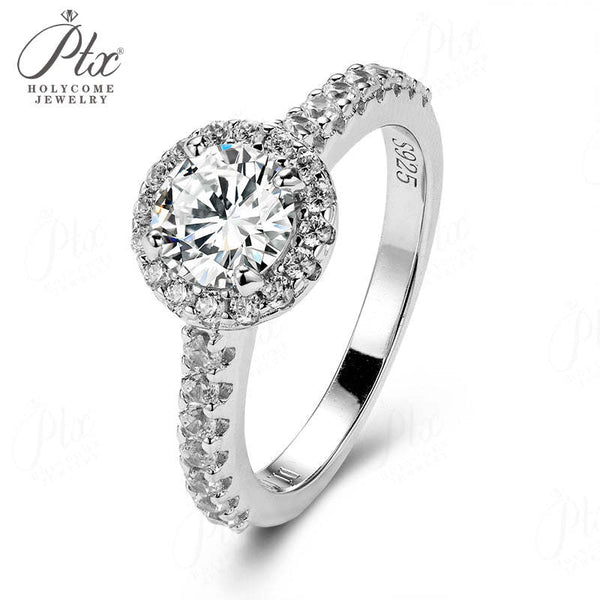
| 1ct to 3ct | +$4.54 | A 6.5mm stone becomes a 9.3mm stone |
| 2ct to 3ct | +$0.49 | Half a millimetre of diameter |
| 3ct to 4ct | +$79.78 | Rough cost arrives; the stone dominates the hand |
| Silver to 14K | +$86.35 | Colour that does not tarnish, and a heavier feel |
| 14K to 18K | +$162.34 | Richer yellow, softer metal, same look to most eyes |
| Silver to PT950 | +$464.36 | Density and permanence; no visual change at all |
The carat step from 1 to 3 costs about a hundredth of the metal step from silver to platinum, and the visual difference is enormous against a change nobody can see. That is the whole decision, laid out in one table.
The order I would spend in
First, cut and setting style — the two things that decide how the piece reads from a metre away, and the two that cannot be corrected later. Second, metal, because a tarnish-free ring you keep wearing beats a prettier one you stop wearing. Third, carat, which is nearly free and should be taken almost as a default. Fourth, and only if the budget is genuinely spare, above 3ct.
The reason to put cut first is mechanical. A 3ct stone with a window in the middle, where you can see straight through to the skin, looks cheaper than a well-cut 1ct. The eye reads light before it reads size, and a stone that leaks light reads as glass regardless of its diameter.
What a bad cut looks like
A window is a transparent patch where the pavilion angle is too shallow to return light. Extinction is the opposite — dark patches where light is lost sideways. A fish-eye is a ring of reflection around the girdle from too shallow a crown. All three are visible in a photograph if you know to look, and all three are invisible if you are looking at carat weight.
FAQ
Does a bigger stone really cost almost nothing more?
Between 1ct and 3ct in our own range, yes: $4.54 at the median. It is a manufactured material, so size costs growth time rather than rarity.
Why is a 4ct stone so much dearer?
Yield. Large rough is scarce even in a factory, and a stone that size is cut individually. Expect the price to step rather than slope above 3ct.
Can I judge cut from a photograph?
Partly. Look for a sharp bright centre, an even pattern of light and dark, and no see-through patch. Ask for a video in daylight; a still image can hide a window behind the camera angle.
Is 3ct too big for everyday wear?
It sits about 9.3mm across and stands proud of the finger, so it catches on knitwear and door frames. For daily wear, 1ct to 2ct is the practical band; 3ct is a choice about presence rather than a default.
What we make
We have run our own factory in Guangxi since 2008, cutting and setting GRA-certified D-colour VVS1 moissanite and IGI-certified lab-grown diamond in 925 sterling silver, 9K, 14K and 18K gold, and PT950 platinum. Our 708 listings run from $17 to $2,020, median $95.42, and we publish the carat ladder above rather than describing size in adjectives.
Shipping is free over $99 and $5.99 below it, with 30-day returns on unworn pieces in original packaging. Order the stone size you think you want with the cheapest metal you can tolerate, look at it in daylight, and spend the rest on the setting once you know the diameter is right. We ship direct from the factory, so clearance times are outside our control.