Splitting a Wedding Jewelry Budget Across Four Pieces
Quick Answer: Four pieces — engagement ring, wedding band, and two more of your choosing — do not need four separate budgets. Across our 708 active pieces the median is $95.42 and the middle half of the catalogue runs from $66.65 to $169.26, so a four-piece set assembled at that median costs around $380 before sizing. The allocation question is where to spend above the median, not whether to.

Bridal jewelry spending usually gets planned one item at a time, which is how couples end up with a $900 engagement ring and a $60 band that does not match it. A single budget, split deliberately, produces a more coherent set for less total money — and it makes the trade-offs visible while you can still make them.
The split below assumes four pieces, which is the common shape: the engagement ring, the wedding band, and a pair of pieces worn on the day — earrings and a necklace, or a bracelet instead of one of them. Adjust the proportions, not the principle.
Start With a Total, Not a Per-Item Ceiling
A per-item ceiling produces a set that looks assembled rather than chosen. A total budget forces you to rank the pieces, and ranking is what makes the result cohere.
Anchor the total on real numbers. Our average paid order is $187.17 across 31 orders — every product type, not bridal alone. A four-piece bridal set is naturally a larger order than that average, so plan for two to three times it if you want all four pieces new, or reassign one piece to something already owned.
A Four-Piece Allocation That Holds Up
This split is built around where the money actually buys visible difference. The engagement ring takes the largest share because it is worn alone and photographed most; the band takes the smallest because a plain band does its job at any price.
| Piece | Share of budget | What the money buys | Cut here first? |
|---|---|---|---|
| Engagement ring | 50–55% | Stone size, setting quality, metal | No — this is the piece people look at |
| Wedding band | 15–20% | Metal match to the ring, width, comfort | Yes — a plain band is fine |
| Earrings | 15% | Stone match, setting security for daily wear | Sometimes — studs beat drops on cost |
| Necklace or bracelet | 10–15% | Chain quality, pendant setting | Yes — a pendant on a thin chain reads fine |
On a $400 total that reads as $200 for the ring, $70 for the band, $60 for earrings and $70 for the last piece. On $800 it doubles and the ring absorbs the extra more easily than the band does.
Why the Ring Gets Half
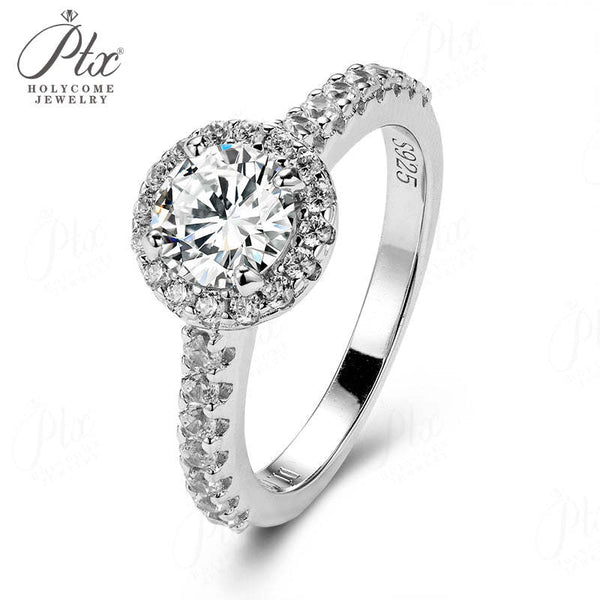
The engagement ring is the only piece in the set that is worn alone most days and inspected at close range by everyone who meets you. It is also the piece with the most price sensitivity per millimetre of stone, because the setting and the metal are visible at a glance.
Our ring catalogue has 204 pieces and a median of $97.97, which sits just above the site-wide figure of $95.42. Spending the ring's share anywhere in that middle band buys a silver setting with a competently cut moissanite — the look most people are actually after.
Why the Band Gets the Least
A wedding band's job is to match the ring's metal and survive daily wear. Neither of those requires a large budget. Silver bands sit in our $50–$100 block, which holds 98 of 204 rings, and a plain 2mm band lands at the bottom of it.
The one thing not to cut is metal matching. A silver ring with a gold band will abrade both over years of contact. Order the band in the same metal family as the ring, and spend the saved money on the ring instead.
Matching Earrings and Necklace
These two pieces exist to make the set read as a set. The cheapest reliable way to do that is to match the stone type and the metal, not the design. Moissanite earrings and a moissanite pendant in the same metal will read as a set even if the settings differ.
Our earring median is $99.18 across 183 pieces with a range of $15.50 to $2,389.58; necklaces median $114.15 across 134. Both categories have plenty of room under $100, which is where the 15% and 10–15% shares usually land.
The Reallocation Levers, in Order
If the total has to come down, take money out in this order. Each step costs less visible quality than the one below it.
- Drop the fourth piece. Three pieces instead of four removes 10–15% with no loss to the set.
- Simplify the band. Plain instead of stone-set, half eternity instead of full.
- Reduce necklace chain width. A 1.2mm chain at a $114.60 median against 3mm at $154.31 is a real saving on a piece that carries little weight.
- Change the ring's stone, not its size. Moissanite at a $91.00 median against lab-grown diamond at $221.20 is the single largest lever in the whole plan.
- Change the ring's metal last. Silver at a $103.78 median against K gold at $339.58 is the biggest saving available, and also the one that changes longevity most.
Do Not Reallocate From the Setting
There is one line in the budget that should not shrink: the structural quality of the ring's setting. Prong count, shank thickness and a gallery rail cost little and prevent the failures that arrive in year three.
A ring that loses its center stone because four short prongs spread is not a saving. If the budget is tight, cut stone size — in our catalogue a 5ct median of $127.92 against a 1ct median of $99.18 means even a five-carat centre costs far less than the setting — and keep the setting sound.
Timing and Shipping Change the Total
Ordering four pieces together is cheaper than ordering them across four occasions, because shipping is free over $99 and $5.99 below it. A single $60 earring order pays $5.99; the same earrings inside a $400 set pay nothing.
Sizing is the other timing cost. Rings ordered before a final measurement may need a resize, and a resize on a gold band costs more than on silver. Measure twice, order once, and use the 30-day return window only for genuine fit failures rather than as a sizing tool.
Where We Fit
We make all 708 pieces in our own factory in Wuzhou, so a four-piece set can be assembled from one place with matched metals and matched stone types. The women's ring collection covers the ring and band side; the earring and necklace pieces sit in their own collections at medians of $99.18 and $114.15.
Shipping is free over $99 and $5.99 below, returns run 30 days, and sales@holycome.com will confirm metal and stone matches across pieces before you order. If the set will be built around moissanite throughout, the moissanite collection holds 525 pieces at a $91.00 median and makes matching straightforward.

FAQ
How should I split a wedding jewelry budget across four pieces?
Roughly 50–55% to the engagement ring, 15–20% to the band, 15% to earrings and 10–15% to a necklace or bracelet. The ring takes half because it is worn alone and seen closest.
What does a four-piece set cost in your catalogue?
Assembled at our site-wide median of $95.42 per piece, around $380 before sizing. Our average paid order across all product types is $187.17, so a full bridal set is naturally a larger order than that.
Can I buy the band later?
You can, but order it from the same metal family as the ring. A silver ring paired with a gold band will abrade both over years of contact, and that damage is not repairable by polishing alone.
Is it cheaper to buy all four pieces at once?
Yes, on shipping. Free shipping applies over $99, so four pieces in one order pay nothing, where four separate orders below the threshold would each add $5.99.
Where should I cut if the budget is tight?
Drop the fourth piece, then simplify the band, then change the ring's stone from lab-grown diamond to moissanite. Leave the setting's structural quality alone — prong count and shank thickness are the cheapest insurance you will buy.