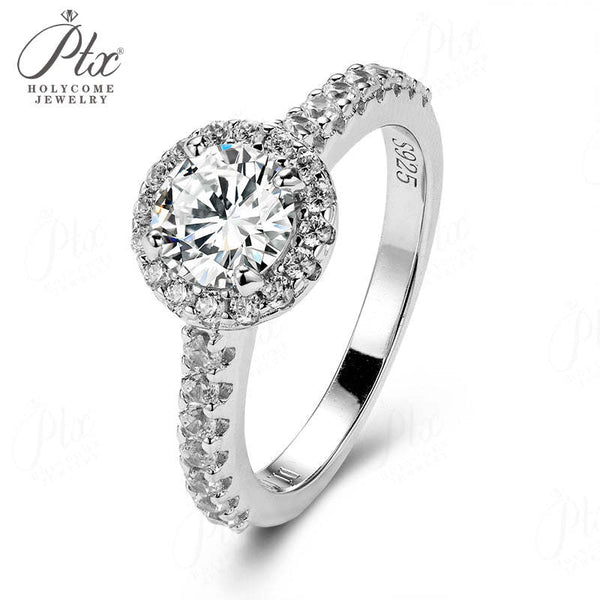
Moissanite at 2ct, 3ct and 4ct: What Each Step Adds

Quick Answer
Pooling every priced variant in our catalogue by the carat weight printed on it: 2ct centres at $128.61 across 1,058 variants, 3ct at $151.96 across 795, and 4ct at $216.00 across 481. Going from 2ct to 4ct moves the middle of the pile by $87.39, or 67.9%.
That is the honest shape of the curve: a step up, not a wall. Carat weight is one input among several, and the other inputs move the number more.
The three numbers, side by side
| Carat weight | Variants priced | Median | Lowest | Highest |
|---|---|---|---|---|
| 2ct | 1,058 | $128.61 | $22.27 | $3,899.76 |
| 3ct | 795 | $151.96 | $25.72 | $4,487.99 |
| 4ct | 481 | $216.00 | $29.17 | $1,718.58 |
Read the ranges, not just the medians. Each band spans an order of magnitude, because a 3ct stone can sit in a thin silver pendant or in an 18K gold ring with a paved band. The stone is the constant; the setting is the variable.
Why the jump is smaller than buyers expect
People assume doubling carat weight doubles price. In set jewellery it does not, for a structural reason: the stone is a small share of the total. A 2ct and a 4ct moissanite in the same silver setting differ by a few tens of dollars of material. The rest of the price — casting, setting labour, finishing, packaging — is identical for both.
Where carat does bite is above roughly 5ct, and again in gold. A larger stone needs a heavier setting to hold it safely, so the metal requirement scales with the stone. That is why the 4ct band has a higher ceiling than 3ct even though its median is not much higher.
What actually moves the price
Ranked by how much they change the number in our own catalogue:
- Metal. Silver sits at $137.27 median across 5,390 variants; gold at $355.63 across 6,603. Roughly a 159.1% difference.
- Setting complexity. A solitaire holds one stone with four prongs. A halo, a three-stone or a pave band holds dozens, and each one is set by hand.
- Carat weight. Real, but third on the list.
- Stone type. Moissanite, lab diamond and coloured gems price differently at the same carat weight.
How to use this when you are choosing
Decide the setting and metal first, then the carat weight last. Buyers who fix a budget and start at carat weight end up shopping between two categories that differ by hundreds of dollars for reasons that have nothing to do with the stone.
If the look you want is a large stone, a 4ct or 5ct moissanite in silver is reachable at the lower end of its band. If the look you want is a fine piece, gold at 2ct will cost more than silver at 5ct — the metal decides, not the carat.
Browse the moissanite ring collection to see the bands in practice, or read our carat price jump breakdown for the 0.5ct starting point.
Comparing the three steps honestly
| Step | Median change | What it buys |
|---|---|---|
| 2ct → 3ct | $23.35 | A visibly larger stone, same setting class |
| 3ct → 4ct | $64.04 | Statement size, heavier setting required |
| 2ct → 4ct overall | $87.39 | The full jump across the range |
The middle step is the expensive one. Moving from 3ct to 4ct crosses the point where a setting built for 2ct is no longer adequate, so the metal and gallery cost rise with the stone rather than staying fixed.
Why the 3ct median sits below 2ct
This is a stocking pattern, not a pricing rule. Our 2ct stock includes more halo and multi-stone designs, which push the median up; the 3ct stock has proportionally more straightforward solitaires. The same inversion appears at 5ct against 2ct for the same reason.
What it means for you: never use a category median as a quote. Use it to locate the ballpark, then price the specific piece. If you want to know what a carat step costs, open one product and switch the option — that number is real in a way a pooled median is not.
Which step most buyers take
The jump from 1ct to 2ct is the one that changes how a ring reads. Below 2ct, a solitaire is an everyday piece; at 2ct it becomes noticeable. Above 3ct the change is more about presence than about a qualitative shift, and the cost per unit of visual improvement gets worse.
That is why 2ct is the practical ceiling for most buyers and 3ct the point where you are buying a look rather than a stone.
Settings that scale with the stone
A four-prong head built for a 1ct stone will hold a 2ct but will look undersized and be less secure. At 3ct and above, expect a taller gallery and a wider band, and expect to pay for both. If a quote for a 4ct piece seems close to a 2ct piece, ask whether the setting was actually scaled or just reused.
The visual tell is the band: a wide stone on a thin band looks unbalanced and will spin. Properly scaled, the band width grows with the stone.

FAQ
Is a 4ct moissanite much more expensive than 3ct?
In our catalogue the median moves from $151.96 at 3ct to $216.00 at 4ct. Both bands are wide, so a specific pair of pieces can differ by more or less than that.
Why is the highest 4ct price so far above the median?
Large stones in gold with complex settings. The $1,718.58 ceiling is a multi-stone or heavy-gold piece, not a solitaire.
Does carat weight change the setting cost?
Yes, above a threshold. A heavier stone needs more metal to hold it securely, so the setting cost rises with the stone at the top of the range.
Should I buy 2ct or 3ct?
Judge by the finger coverage you want, not the number. On a US 6 finger a 2ct round reads as a substantial solitaire; 3ct reads as a statement ring.
Can I get a 4ct in silver?
Yes, and it is the cheapest way to a large look. Check the specific piece — some large stones are only offered in gold for structural reasons.