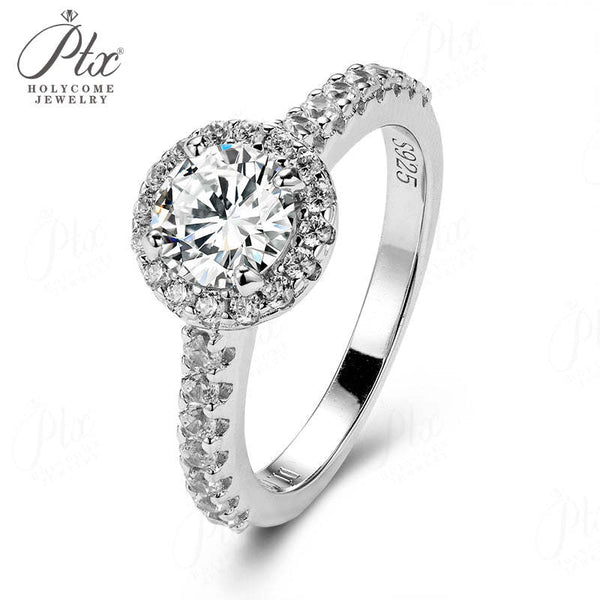
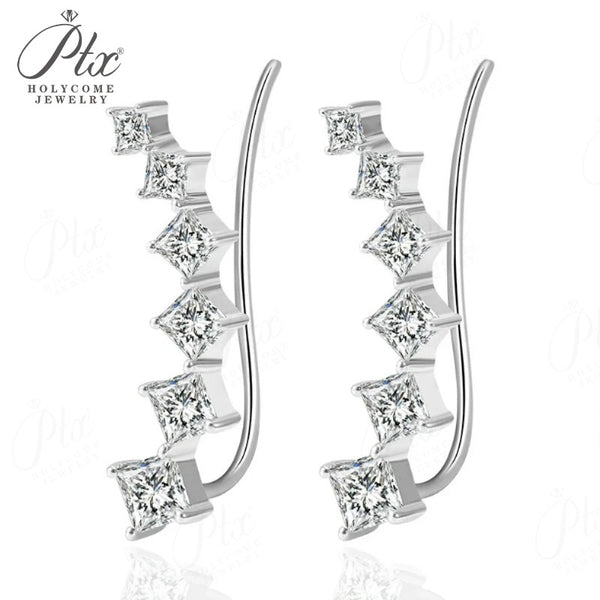
Judging Jewellery From Photos: What You Cannot See

A product photograph is an argument, not a record. It can show you proportion, setting and finish with real accuracy; it cannot show you weight, and the three things buyers most often get wrong — colour saturation, stone size and plating — are precisely the three that retouching is best at.
What a photograph genuinely does show
Photographs are faithful about geometry. If the band is 2mm wide and the head seats a 5mm stone, a straight-on photo shows that relationship correctly, because proportion survives compression and cropping.
So start with the maths the image can support: does the stone look plausible against the band, does the band look equal all the way round, is the setting symmetrical, is there a visible gallery under the stone or does it sit flat on the metal?
Proportion is the honest signal
Look for the tells that are hard to fake. A band whose edges are parallel in a front view is machined or cast to a consistent section; one that narrows sharply at the bottom has been tapered, usually to save metal. A claw that crosses the girdle of the stone at an angle sits badly. A pair of earrings photographed side by side that differ in outline by a millimetre were not matched at the bench.
Setting and finish
Finish reads well in photographs when the lighting is honest. Look at the reflection of the light source in the metal: a clean surface returns a straight, unbroken highlight, while a surface with tool marks, porosity or a bad polish returns a wobbling one. Cast porosity shows as tiny dark pits near the sprue or under the head, and it is visible at product-photo resolution.
What retouching changes: colour
Metal colour is the easiest lie. Saturation and warmth sliders turn 9K yellow into 18K yellow, and turn a palladium-white alloy into the cold white of rhodium. This matters: 9K is noticeably paler than 18K in daylight, and a buyer expecting the second will blame the seller for the first.
Gemstone colour goes the same way. A D-colour stone photographed on a grey card under 5500K light reads honestly; the same stone on a blue-white sweep with a saturation lift reads a full grade higher. Ask for a photo on a neutral background and one in daylight if colour is the reason you are buying.
What retouching changes: stone size
Stones can be enlarged by shooting wide and cropping tight, but the common trick is subtler: a macro lens at close focus with the band blurred behind makes the head dominate the frame. The stone is not enlarged; everything else shrinks.
A one-carat look on a 1.2mm band is a photographic effect, not a mounted stone. Compare the stated stone diameter against the stated band width, and treat an unstated diameter as unverified.
What retouching changes: plating and surface
Plating thickness cannot be photographed at all. A 0.5-micron flash and a 5-micron layer look identical on the day of the shoot and diverge within months. High-key lighting also hides scratches, so a resold piece photographs better than it wore.
| What you can see | What it tells you | What it cannot tell you |
| Band-to-stone proportion | Whether the design is balanced or a head on a thin shank | Gram weight, thickness at the base |
| Highlight quality | Polish level, presence of porosity | Alloy purity, depth of plating |
| Setting geometry | Claw placement, seat depth, symmetry | Stone grade, certificate validity |
| Colour on neutral ground | Approximate alloy tone and stone tint | Anything after a colour profile is applied |
Using a reference object to judge size
The only reliable scale in a photograph is a thing of known size: a coin, a ruler, a hand. If the seller includes one, compare that ratio to the stated millimetres — a check that the listed width is real.
When no reference exists, use your own body. On most adult hands the little fingernail is roughly 11mm across, which gives a workable scale for band and stone, accurate to a millimetre or so.
Product shots versus worn shots
A product shot answers "what is this", a worn shot answers "what will this look like on me" — and the second is the one that predicts regret. The same 3mm band photographed alone reads substantial and reads thin next to a 2mm wedding ring on a finger.
Ask for both, and ask for the worn shot on a hand near your ring size. Sellers who shoot everything on the same size-six hand show half their customers a photograph that is wrong for them.
Questions a photo cannot answer
Weight, plating thickness, alloy purity, whether the certificate covers the stone pictured, and how the piece looks after two years. Those come from specifications, stamps and return terms — the boring parts of a listing, which is why they are the parts worth reading.
What we make
Our pieces are cast and finished at our own factory in Guangxi, which we have operated since 2008, in 925 sterling silver, 9K, 14K and 18K gold, and PT950 platinum. Moissanite is GRA-certified at D colour and VVS1; lab-grown diamonds carry IGI reports. Prices run from $17 to $2,020, with a typical piece around $98.
We photograph on a neutral ground and publish band width, thickness and stone diameter in millimetres, so the picture can be checked against the specification. Shipping is free over $99 and $5.99 below. Returns run 30 days on unworn pieces in original packaging, which lets you compare the object to its photograph in daylight. Orders ship direct from the factory, so clearance times are not ours to promise.