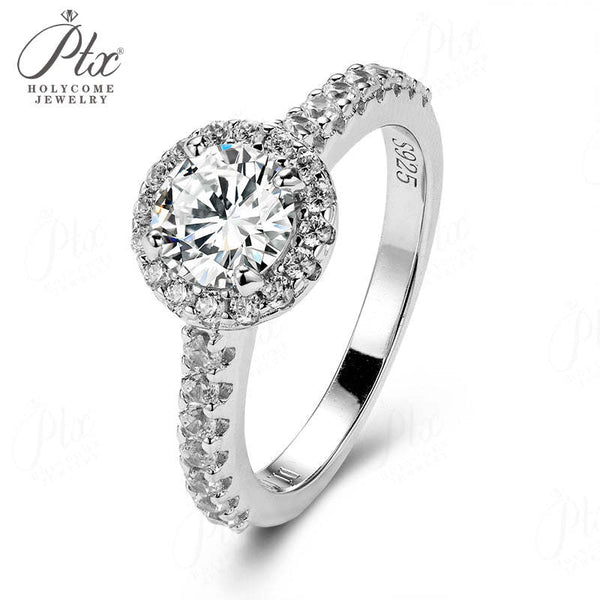
A $100 Ring That Does Not Look Like a $100 Ring
Quick Answer: At $100 you are almost exactly at the median of our ring catalogue — $97.97 across 204 pieces, with 106 of them priced under $100. What makes a cheap ring look cheap is not the price. It is four specific details: a thin shank, a stone too small for its head, four thin prongs, and dull white metal. All four are fixable at this budget.

The rings that look inexpensive at a hundred dollars share a look: a band thin enough to flex, a stone a size or two below what the head was designed for, mismatched side stones, flat metal. None of that is a price outcome — a $300 ring can carry all four. Here is where to put the hundred instead, in order of visual return.
Detail One: the Shank
A thin shank is the single most reliable tell of a cheaply built ring, and it reads at a glance even to someone who knows nothing about jewelry. It looks delicate in a way that suggests fragility rather than refinement, and it flexes when you handle it.
Ask for shank thickness in millimetres. A shank below about 1.6mm at the base is thin; narrower than 1.5mm and it will deform. Above 2mm it holds its shape in the hand and photographs as solid.
Our rings start at $17.00 and the category median is $97.97, so thickness is not what the money buys — it is what the design specifies. A hundred-dollar ring with a 2mm shank will outlast a three-hundred-dollar ring with a 1.4mm one.
Detail Two: Stone Size Relative to the Head
A ring looks wrong when the head is built for a 2ct stone and fitted with a 0.5ct one. The gap is what reads as cheap — not the carat weight itself.
This is the good news. In our catalogue the price curve for moissanite rises far more gently than a mined diamond's: the 1ct median is $99.18, the 2ct median is $103.23, and the 5ct median is $127.92. Four extra carats of centre stone cost under $30 at the median. A buyer at $100 can have a 2ct centre outright, and a 5ct centre for roughly a third more than a 1ct — which means the ring can be built in proportion rather than shrunk to fit a budget.
| Title carat | Rings | Median price | Practical read |
|---|---|---|---|
| 0.5ct | 13 | $88.46 | Deliberately small; works in a bezel or as a stacker |
| 1ct | 79 | $99.18 | The most stocked size, and the safe default |
| 2ct | 47 | $103.23 | Four dollars more than 1ct — proportions open up |
| 3ct | 32 | $103.72 | Needs six prongs and a substantial shank |
| 5ct | 10 | $127.92 | Stocked in volume; not an exotic order |
At 5ct the setting has to be built for it, and that is the one place a cheap-looking result is unavoidable: a large stone in a light setting looks like a large stone in a light setting, whatever it cost.
Detail Three: the Prongs
Four thin prongs on a large center is the classic economy build, and it shows. Six prongs read as deliberate, hold the stone better and distribute wear. Above a 6mm center, six is the minimum worth accepting.
Prong shape matters too. Rounded claw tips catch light and look finished; flat, filed tips look unfinished because they are. The gallery rail — a thin horizontal bar under the stone — reduces prong spread and makes the head look engineered rather than improvised.
Detail Four: Metal Color and Consistency
Dull metal is the easiest problem to fix and the most common. Silver tarnishes, and a tarnished ring reads as old regardless of age. White gold without rhodium plating reads yellow-grey.
Our silver pieces median $103.78 and our K gold pieces $339.58. At a hundred dollars you are in silver, and that is fine — silver polished properly looks the same as white gold at arm's length. The requirement is that it arrives polished and stays that way, which means a rhodium flash or a good final polish and dry storage.
Color choice also matters at this price. Yellow gold at $340 puts a ring out of the hundred-dollar band; silver, white-toned and two-tone finishes keep it in. If the goal is a ring that reads as gold, a yellow-toned finish over silver is the compromise — and it will wear, so weigh that.
Where to Spend, Where to Save
A hundred dollars splits usefully. Roughly half is the stone, most of the rest is the metal and setting, and a small share is finishing. Redistribute it like this.
- Spend on: shank thickness, prong count, a gallery rail, and a proper polish.
- Save on: stone size, which costs almost nothing to increase in moissanite.
- Save on: side stones. A plain shank reads cleaner than a poorly matched pavé line.
- Save on: fancy shapes as a cost driver — round medians $85.88 against radiant at $156.98.
The Comparators That Matter
Two rings at $100 can differ entirely. Compare these, not totals:
| Check | What a good $100 ring shows | What a bad one shows |
|---|---|---|
| Shank thickness | 2mm or more at the base | Under 1.6mm, flexes in the hand |
| Prong count | Six above a 6mm center | Four thin prongs on a big stone |
| Gallery rail | Present under the girdle | Open air beneath the stone |
| Side stones | Matched in size and color | Uneven, or absent without reason |
| Metal finish | Bright, even, no tool marks | Dull, patchy, visible solder line |
| Stone setting | Stone sits level, table parallel to shank | Tilted or sunk below the prong tips |
What $100 Does Not Buy
It does not buy gold, and it does not buy a large certified diamond. Our lab-grown diamond pieces median $221.20 and the gold step lands near $339.58, so both sit above the band.
It does not buy hand engraving, milgrain work or a full eternity of side stones. Those are time and stone count, and time does not compress.
The Photograph Test
Look at a listing photo from the side, not the top. The side view shows shank thickness, head height, the rail and whether the prongs were finished. Top-down photography hides all four.
Then look at the hand shot if there is one. Scale is the thing most often misrepresented.
Where We Fit
We make 708 pieces in our own factory in Wuzhou, 204 of them rings, and 106 of those are under $100 — the largest single block of our inventory. Factory direct with no distributor is what allows a hundred-dollar ring to carry a 2mm shank and six prongs rather than a thin band and four.
The women's ring collection is where most of that block sits. Shipping is free over $99 and $5.99 below, returns run 30 days, and sales@holycome.com will confirm shank thickness and prong count for a specific piece before you order.
One practical note on the threshold: our ring median of $97.97 sits just under $99, so a single ring typically pays $5.99 in shipping. Adding a band or a pair of studs clears it, and the moissanite collection has 525 pieces at a $91.00 median if you want to combine.

FAQ
Can a $100 ring look expensive?
Yes, if the money goes into the shank, the prongs and the finish rather than into a brand. Our ring median is $97.97, and 106 of 204 rings are under $100 — a hundred dollars is the middle of the catalogue, not the bottom.
What makes a cheap ring look cheap?
Four things: a shank under about 1.6mm that flexes, a stone that is too small for its head, four thin prongs on a large center, and dull or unplated metal. None of them is a price outcome.
Should I buy a bigger stone or a better setting?
The setting. In our catalogue a 1ct median of $99.18 against a 5ct median of $127.92 means size costs less than the setting does, so spend the difference on shank thickness and prong count.
Does silver look cheap next to white gold?
Not at arm's length, and particularly not when new. Our silver pieces median $103.78 against $339.58 for K gold — the visible difference is tarnish over time, not the look on day one.
Which shape gives the most ring for $100?
Asscher at a $68.03 median or round at $85.88. Radiant medians $156.98, so it is the shape to avoid if the budget is fixed at a hundred dollars.