Tension Settings: What They Promise and What They Require

A tension setting clamps the stone between two sprung shanks, so the stone itself becomes part of the structure. It looks effortless and it is the least forgiving setting made — the stone has to be hard, thick-girdled, and the ring can never be resized.
What "tension" means in metal
Two shanks run up the sides of the ring and stop short of each other, leaving a gap. The stone bridges that gap. At each end of the gap a shallow recess — 0.3mm to 0.5mm deep — is cut to match the curve of the girdle, and the shanks are sprung apart by 0.4mm to 0.8mm when the stone is pressed in. That stored deflection is the entire mechanism. There are no claws, beads or bezel wall.
The stone is load-bearing: every knock travels through the girdle into the metal, and back.
What the stone has to be
Hardness of 9 or above is the practical floor. Diamond at 10 and moissanite at 9.25 are the two natural candidates; sapphire and ruby at 9 work if the girdle is thick and free of inclusions at the contact points. Emerald, at 7.5 to 8 with its brittle structure and internal fractures, is not suitable — the recess concentrates stress on exactly the two spots where an emerald is weakest.
The girdle has to be medium to thick, roughly 0.9mm to 1.3mm on a 6.5mm stone. A thin or extremely thin girdle will chip in the recess on the day it is set, or six months later. And the shape has to have two roughly parallel, straight bearing surfaces: round, oval, cushion, square and rectangular work. Marquise and pear do not, because the point cannot be clamped without crushing it.
Why the alloy matters more than the design
A tension setting only works if the metal stays sprung. Sterling silver does not: annealed 925 silver is soft enough that the shanks relax under load, and a ring that relaxed has lost its grip with nothing visibly wrong. Hardened 14K, 18K gold and PT950 platinum hold the deflection, which is why nobody making them properly offers silver.
Section size matters as much as alloy. Each shank needs 2.5–3.0mm of width and 1.8–2.2mm of depth at the gap. Thinner, and the metal fatigues, the gap widens, and the stone rocks in its recess before it leaves.
What it promises
A stone that appears to float, with no claws in the way of the light and nothing to catch on a jumper. The full crown is visible from the side, the profile is low, and cleaning is easy because there is no gallery to reach into.
What it requires of you
Acceptance that the ring is a single fixed object. No resizing, no sizing beads soldered inside, no re-tipping in five years because there is nothing to re-tip. Have the recess checked once a year, and treat a hard knock on a stone edge as a reason to have it looked at rather than something to monitor.
The failure mode is also different from a claw setting. A tension setting holds until it does not, then the stone is out.
Resizing: the honest answer
It cannot be resized. Sizing requires annealing and soldering, and both destroy the work-hardening that provides the spring; you cannot re-harden a finished ring reliably, and the recesses have to be re-cut to match the new diameter. Half a size, done by the original maker with the original jig, is the outside limit. Buy the correct size or do not buy the ring.
Repair and replacement
Replacing a stone needs the maker's press to spring the shanks and seat a new stone of matched girdle thickness — a local jeweller will usually decline, and should. A cracked or broken shank means a remake, not a repair, because the two halves have to be re-sprung and matched as a pair. Expect structural work to go back to the maker, in weeks.
Price and risk
| Aspect | What it means | If it goes wrong |
| Stone hardness | 9 or above; thick girdle | Chip at the recess, not at the table |
| Metal | Hardened 14K, 18K, PT950 | Shanks relax; grip is lost invisibly |
| Shank section | 2.5–3.0mm wide at the gap | Fatigue, widening gap, stone rocks |
| Sizing range | Half a size, maker only | Ring is effectively unsellable secondhand |
| Stone replacement | Factory press and matched girdle | Local jewellers decline the job |
| Bench cost | Several hours plus a custom cast | Typically hundreds above a claw setting |
Who should avoid one
Anyone whose size might change — pregnancy, weight change, a gift bought without an exact measurement. Anyone with active hands, or a job involving lifting and gym equipment. Any stone under about 5mm, because there is not enough girdle length to clamp. And any coloured stone other than sapphire or ruby.
What we make
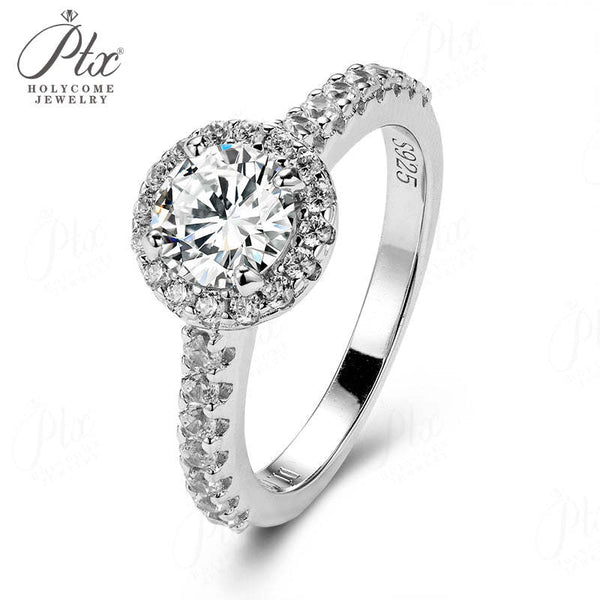
We do not make tension settings, and the reason is the one above: they cannot be sized, and most of the rings we ship go out as gifts where the size is an estimate. Instead our Guangxi factory, working since 2008, builds four-claw, six-claw, bezel, halo and pavé settings in 925 sterling silver, 9K, 14K, 18K gold and PT950 platinum — all of them adjustable by one to two sizes, all of them re-tippable.
Stones are GRA D colour VVS1 moissanite at 9.25 hardness, IGI certified lab-grown diamond, and lab-grown emerald, ruby and sapphire. Prices run $17 to $2,020 with a median around $98; free shipping over $99, otherwise $5.99; 30-day returns on unworn pieces in original packaging, excluding custom and engraved work.