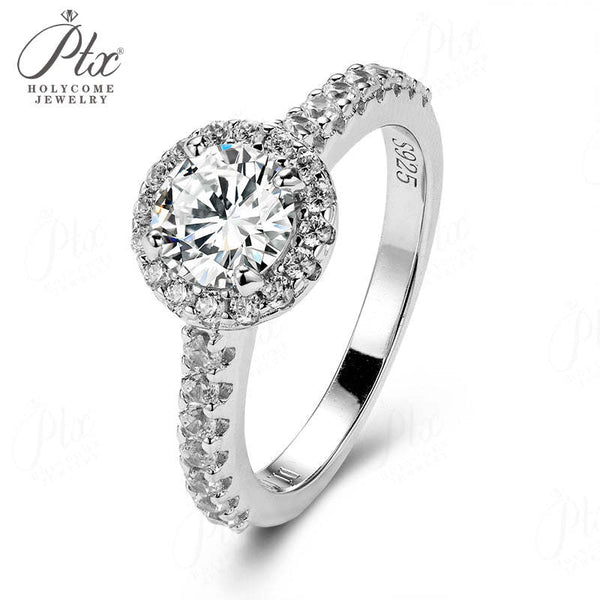
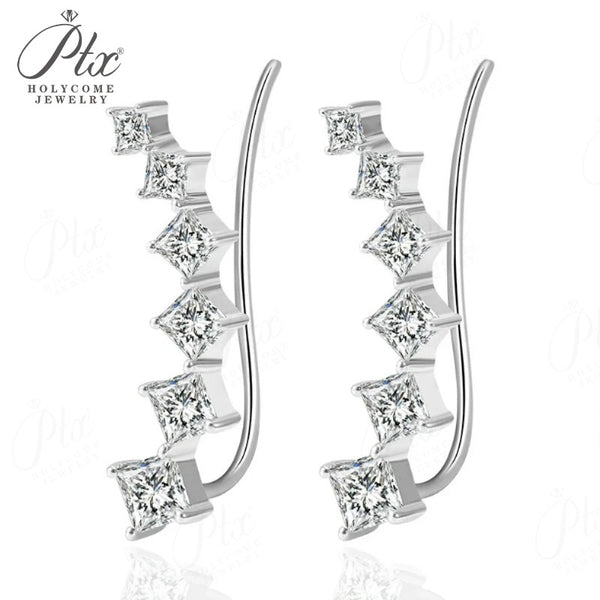
Moissanite vs Cubic Zirconia: What the Price Difference Actually Buys

CZ costs a few dollars. Moissanite costs thirty times more. Here is what that difference actually buys. They are both colourless, both cut in the same shapes, and both photograph almost identically on a white background. The difference shows up in three places: hardness, how the stone ages, and what it does to light. Only one of those is visible on day one.
The short answer
Cubic zirconia is a synthetic stone made of zirconium dioxide. It is cheap to produce, it looks bright when new, and it degrades. Moissanite is silicon carbide — harder, physically stable, and it does not cloud over time. If the piece is something you wear weekly for years, moissanite is the material that survives. If it is a costume piece for one evening, CZ is fine and nobody should pay more.
Hardness: 8.25 versus 9.25
Hardness decides how long a polished surface stays polished. On the Mohs scale:
- Cubic zirconia — 8 to 8.5. Soft enough to pick up micro-scratches from daily contact with keys, counters and other jewellery.
- Moissanite — 9.25. Harder than any common abrasive you will meet in daily life, apart from diamond.
- Diamond — 10. The reference point neither of the others reaches.
A CZ stone worn daily typically shows visible surface wear within a year to eighteen months. The facet edges round off, and a rounded facet edge stops reflecting light cleanly. That is what people mean when they say a CZ "went dull" — the stone did not change, its surface did. Moissanite at 9.25 holds a polish far longer, and when it does dull it is usually a film of soap and skin oil on the surface, not damage to the stone.
Clouding: the real dividing line
This is the part that is rarely said plainly. CZ is porous at a microscopic level compared to moissanite, and it absorbs oils and chemicals from skin, soap and perfume over time. Once that material is inside the stone, it scatters light instead of transmitting it, and the stone reads cloudy or milky rather than bright. It cannot be cleaned back to new, because the contamination is not on the surface.
Moissanite does not do this. It is chemically inert in normal wear. A moissanite ring that looks dull after two years is almost always dirty on the outside, and warm water with dish soap and a soft brush brings it back completely. That difference — recoverable versus permanent — is the single biggest practical argument for moissanite.
How they handle light
Diamond and CZ are singly refractive: light enters and leaves along one path. Moissanite is doubly refractive, meaning light splits into two paths inside the stone. In practice this produces two visible effects:
- More fire — moissanite throws noticeably more coloured flashes than diamond or CZ, especially in warm indoor light. Some people love it, some find it too much. It is a genuine difference in character, not a defect.
- Doubling in large stones — above roughly 1.5 to 2 carats, and most visibly in step cuts like emerald and asscher, the doubled facet edges can be seen under close inspection. Brilliant cuts hide it better. Below 1.5ct most people never notice it without being told to look.
CZ does not have this issue, but it also has less fire than moissanite. Neither is "more correct" — they simply look different.
Colour over time
CZ can yellow. Some grades shift toward a warm cast with UV exposure and age, which is why a two-year-old CZ often looks off-white next to a new one. Moissanite's colour is stable; a D colour stone stays D colour. If you are buying a matched pair — earrings, or a three-stone ring — this matters, because mismatched ageing is very visible side by side.
Price: the honest comparison
At the same carat weight, rough order of magnitude:
- CZ — a few dollars per stone. A complete CZ ring can retail under $20.
- Moissanite — roughly $20 to $100 per carat for the stone depending on size and cut, and a finished 925 silver ring typically lands in the $50 to $150 range.
- Lab grown diamond — an order of magnitude above moissanite again.
The price gap between CZ and moissanite is real, and it is roughly thirty to fifty times on the stone alone. Whether that is worth paying depends entirely on one question: is this piece meant to last?
Which one to buy
Choose CZ if the piece is for a costume look, a photo shoot, a single event, or a gift where the recipient knows it is fashion jewellery. There is nothing wrong with this. Spending moissanite money on a piece that gets worn three times is also a mistake.
Choose moissanite if the piece is an engagement ring, a wedding band, an anniversary piece, or anything worn weekly for years. The stone does not cloud, does not yellow, and cleans back to new. On a per-wear basis it is dramatically cheaper than replacing a CZ piece every eighteen months.
Choose lab grown diamond if the certificate and the word "diamond" carry meaning for you or the person receiving it. That is a legitimate reason — provenance and language matter in jewellery — and it costs accordingly.
What we actually make
Every moissanite piece we ship is D colour, VVS1 clarity, and comes with a GRA certificate matched to that specific stone. Lab grown diamond pieces ship with IGI certification stating the growth method. The certificates are packed with the piece, not emailed separately, so you can check the number against the stone when it arrives.
If you are weighing up a specific piece and want to know what the same design costs in CZ versus moissanite versus lab grown diamond, ask us before you order. We make all three, and we will tell you which one makes sense for how often you plan to wear it.