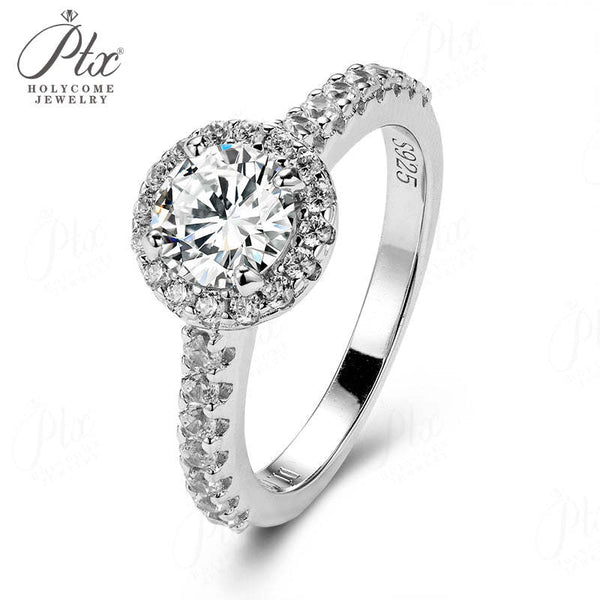
How Much Is a Wedding Set? Ring Plus Band Priced Together
Quick Answer: A wedding set is two rings ordered together, and the pair is cheaper than the sum of two separate purchases — mostly because of shipping. In our catalogue the ring median is $97.97 and a silver band sits in the $50–$100 block, so a matching set typically lands around $150–$200, and clears the $99 free-shipping threshold where either piece alone might not.

The word "set" is used loosely in retail. Sometimes it means a molded pair designed as one unit, sometimes an engagement ring plus a band chosen to sit against it. Pricing behaves differently in each case.
Below is what a set actually costs in our own inventory, how the components break down, and where a paired purchase saves money versus where it does not.
What "Set" Means at Checkout
A true bridal set is an engagement ring and a wedding band made to sit flush against each other, often sharing a contour. A curated set is the same two pieces chosen together but built independently.
True sets cost more, because the contour has to be cut to match and the two pieces have to be finished as a pair. Curated sets cost less and are more flexible: if the band is lost, it is replaced independently.
What almost all sets share is a metal constraint. Two rings worn on the same finger touch, and mismatched metals abrade each other. Order both in the same metal family and the question goes away.
The Component Prices
Here is what each half costs in our listings, from the category medians and band distribution.
| Component | Figure | Notes |
|---|---|---|
| Ring, all 204 | Median $97.97, range $17.00–$2,020.79 | 158 of 204 are under $200 |
| Band, silver plain | In the $50–$100 block | 98 of 204 rings sit in this block |
| Band, K gold | Near the $339.58 K gold median | 77 gold pieces across the catalogue |
| Silver pieces, all categories | 537 pieces, median $103.78 | The baseline most sets are built on |
| Moissanite, all categories | 525 pieces, median $91.00 | Stone cost in a set is small |
Read the first two rows together. A silver ring at the median and a silver band in the band block put a set at roughly $150–$200, which is close to our average paid order of $187.17 across 31 orders — the set is the typical order size, not an outlier.
Why the Pair Costs Less Than Two Singles
Three reasons, in order of size.
Shipping. Free over $99, $5.99 below. Our ring median of $97.97 is deliberately just under that line, so a ring bought alone pays $5.99. A ring and band bought together clear it. On a $150 set that is a real percentage.
Metal matching. Ordering from one source in one metal family avoids the cost of later replacing a band that does not match. That is not a discount so much as an avoided expense.
Single sizing. If both rings need adjustment, one measurement session covers both, and a resize done at purchase rather than later is usually cheaper than a resize done on a finished, worn ring.
Where a Set Does Not Save
A set does not discount the jewelry itself. There is no bundle price in our catalogue; the pieces are priced individually and the saving is in the logistics.
It also does not save if the band is bought at the wrong width. A wide band against a narrow engagement ring will not sit flush, and correcting that means a new band rather than a resize. Measure the combined width across the finger before ordering.
Sets in Gold Versus Silver
The metal decision doubles in a set, because both pieces take it. That makes it the most important choice in the pair.
Silver at a $103.78 median keeps a set near $150–$200. Gold near $339.58 per piece puts a set near $680 or more, because both halves move. Our 18K variants median $346.09, 14K $346.38 and 10K $346.38 — so the karat within gold barely changes the pair's total; the silver-to-gold step is the whole jump.
Given that, the question is not "which karat" but "will both rings come off for water." If yes, two silver rings are rational and the set lands under $200. If no, budget for two gold pieces, which is roughly four times the silver pair.
Stone Content in a Set
The engagement ring carries the visible stone; the band either matches it with a line of small stones or stays plain. Plain is the cheaper and more durable choice, and it does not look like a compromise.
Where a stone band earns its cost is when the engagement ring is a solitaire. A plain solitaire against a plain band reads as two thin rings; a solitaire against a half-eternity band reads as a set. The half version costs roughly half of a full eternity in stone count and setting labor, and unlike a full eternity it can still be resized.
The stones themselves are a small line item. At a $91.00 moissanite median across 525 pieces, a band's stone content is far less than the labor of setting it.
Sizing Both Rings
Two rings on one finger take more room than one. A set sized to the engagement ring's measurement alone will be tight once the band joins it, and the usual correction is a quarter to a half size up on the band.
Wide bands compound this. Our men's collection holds 20 pieces with profiles up to 6.5mm, and the same logic applies to a wide women's band: the wider the band, the larger the size needed for the same finger.
Measure at the end of the day, measure the knuckle, and measure with both rings in mind. Ordering a set, then resizing one half, is how a $150 pair becomes a $180 pair.
The Shipping Arithmetic
One order of two rings at $150: shipping free, one return window, one measurement. Two orders of $97 and $60: the first pays $5.99 for falling under the threshold, and if either needs a return the shipping cost returns with it.
That is not a large sum, and it is worth being clear about the scale — $5.99 against a $150 purchase is about 4%. But it is entirely avoidable, and it is the concrete reason a set prices better than two singles.
Where We Fit
We make 708 pieces in our own factory in Wuzhou and sell direct, so a ring and band can be ordered in the same metal and the same stone type from one place. The women's ring collection covers the engagement side and the bands that sit against it.
Shipping is free over $99 and $5.99 below, returns run 30 days, and sales@holycome.com will confirm that a specific band sits flush against a specific ring before you order — which is the check that prevents most set returns. If the pair will be moissanite throughout, the moissanite collection holds 525 pieces at a $91.00 median, so stone matching across both rings is straightforward.

FAQ
How much is a wedding set?
In our catalogue a silver ring at the $97.97 median plus a silver band in the $50–$100 block puts a set around $150–$200 — close to our $187.17 average paid order. A gold pair moves toward $680, since both halves take the 3.3x metal step.
Is a set cheaper than buying the rings separately?
The jewelry is priced the same; the saving is shipping. Free shipping applies over $99, and our ring median of $97.97 sits just under that line, so a single ring pays $5.99 where a pair does not.
Do both rings need the same metal?
Yes, practically. Two rings on one finger touch constantly, and mismatched metals abrade each other. Order both in the same metal family and that wear does not happen.
Should the band be sized differently from the ring?
Usually a quarter to a half size up, because two rings take more room than one. A wide band needs more again — the same rule that applies to men's bands up to 6.5mm.
Is a half-eternity band enough for a set?
For most people, yes. It costs roughly half of a full eternity in stone count and setting labor, and unlike a full eternity it can be resized after purchase.