GRA vs IGI Certification: What the Certificate Actually Says
What a certificate measures, and what it does not. Most people who ask about certification have already been told something confusing — usually that their stone is "GIA certified" when it is moissanite, or that GRA and IGI are equivalent. They are not equivalent, and understanding what each one actually states protects you from paying for a document that does not say what you think.
Here is what each certificate covers, what it does not, and how to read the one that ships with your piece.
The one-line version
GRA documents moissanite. IGI documents lab grown diamond. GIA documents mined and lab grown diamond but not moissanite. A certificate from the wrong lab for the stone you bought is either a mistake or a misrepresentation.
GRA: moissanite only
GRA (Global Gemological Research Academy) issues certificates for moissanite. It is not a diamond grading laboratory and does not claim to be.
What a GRA certificate typically states:
- Stone type (moissanite)
- Dimensions in millimetres
- Carat or gram weight
- A colour grade (usually expressed as colourless to near-colourless, sometimes with a D-E-F equivalent note)
- Shape and cut style
- A certificate number that matches an inscription or a label on the packaging
What it does not state, because it does not apply: clarity grades on the diamond scale, fluorescence, polish and symmetry grades, or a cut grade. Moissanite does not have the inclusion types diamonds have, so diamond clarity grading would be meaningless.
This is why a GRA certificate looks shorter than a diamond certificate. That is correct behaviour, not a red flag.
IGI: lab grown diamond
IGI (International Gemological Institute) is one of the two major laboratories recognised for lab grown diamond grading, alongside GIA. An IGI certificate for a lab grown diamond is a full grading report and typically states:
- Carat weight, measured to two decimal places
- Colour grade on the D to Z scale
- Clarity grade on the FL to I3 scale
- Cut grade for round brilliants (Excellent, Very Good, Good, Fair, Poor)
- Polish and symmetry grades
- Fluorescence (None, Faint, Medium, Strong)
- Growth method — CVD (chemical vapour deposition) or HPHT (high pressure high temperature)
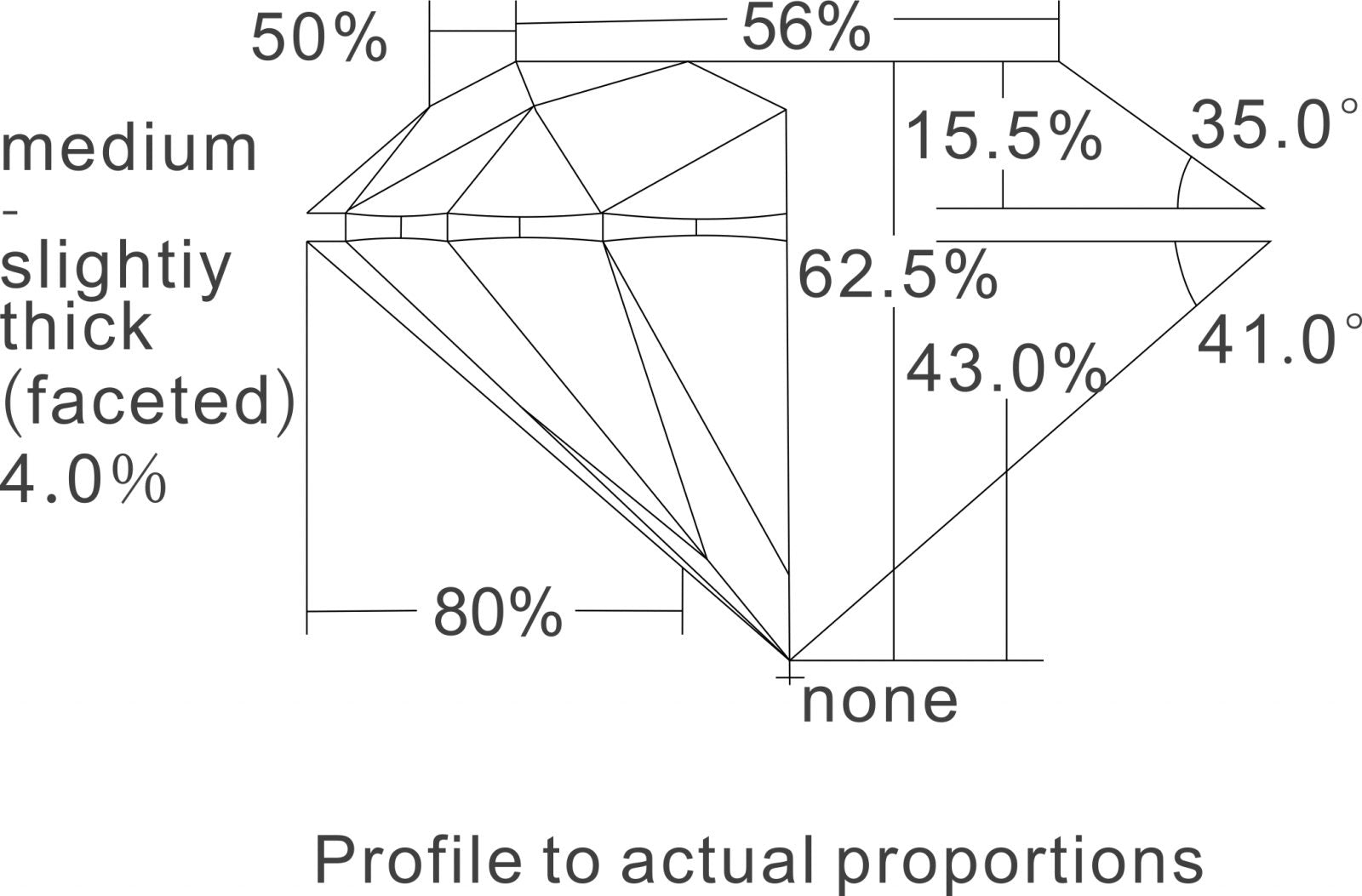
- Measurements in millimetres and the depth and table percentages
- Laser inscription on the girdle, matching the certificate number
- A note confirming the stone is lab grown, with the specific growth method
The inscription matters: it means the certificate cannot be swapped between stones. If the number on the girdle does not match the certificate, the certificate is not for that stone.
GIA: the reference standard
GIA (Gemological Institute of America) invented the modern diamond grading scale. GIA does grade lab grown diamonds and states the growth method on the report, but GIA does not grade moissanite.
If a seller offers "GIA certified moissanite," the certificate either does not exist, is for a different stone, or the stone is not moissanite. There is no fourth option.
What the certificate does not tell you
It does not guarantee the setting. A certificate covers the stone. The metal, the prongs, the plating and the craft are not in it. A perfect certificate in a poorly made setting is still a poorly made ring.
It does not tell you whether the price is fair. Two stones with identical certificates can be priced very differently depending on who is selling them and whether they are manufacturing or reselling.
It does not describe the stone's visual appeal. Cut quality and the arrangement of facets determine how a stone looks far more than the grade on paper. Two D/VVS1 stones can look different.
It does not cover a stone under about 0.30ct. Below that size, certificates are usually not issued, and a seller claiming one for a tiny stone should be asked for the document.
How to verify a certificate
Check the number on the lab's own website. Both IGI and GRA publish certificate lookups. Type the number in; the record that comes back should match the paper you have.
Check the inscription on the stone. For IGI-graded diamonds, the certificate number is laser inscribed on the girdle. A jeweller with a loupe can read it. If it does not match, stop.
Check the weight. A certificate for 2.01ct does not apply to a stone that weighs 1.85ct. If you have the stone weighed and it does not match, the certificate is not for that stone.
Check the growth method for lab grown. IGI states CVD or HPHT. Both are legitimate; neither is inherently better. But if a seller claims one and the certificate says the other, that is a factual discrepancy worth questioning.
The red flags
"GIA certified moissanite." GIA does not grade moissanite.
Certificate emailed separately, not packed with the piece. For a stone over about 1 carat, the certificate should be physically in the box. Emailed certificates cannot be verified against the stone.
A certificate photo that is generic. If the same certificate image appears across multiple listings, it is not matched to a specific stone.
No certificate at all on a stone over 1ct. Moissanite over 1ct should have GRA; lab grown diamond over about 0.3ct should have IGI or GIA.
What ships with ours
Moissanite ships with a GRA certificate matched to the specific item. Lab grown diamond ships with IGI certification, matched to the item, including the growth method. Both are packed with the piece, not emailed separately.
If you need the certificate loose rather than sealed to a card — for example because you are having the stone set locally — tell us when ordering and we will pack it that way.