1ct vs 2ct Moissanite: What the Price Jump Actually Buys

Doubling the carat weight does not double the size, and it does not double the price either. Both curves matter before you decide. This is the arithmetic nobody puts on a product page, laid out plainly.
Size: what you actually see
Carat is weight, not diameter. For round brilliant moissanite, the standard conversions:
- 0.5ct — 5.0mm
- 1.0ct — 6.5mm
- 1.5ct — 7.3mm
- 2.0ct — 8.0mm
- 3.0ct — 9.0mm
Notice the shape of that curve. Going from 0.5ct to 1ct adds 1.5mm. Going from 1ct to 2ct — double the weight — adds only 1.5mm. Going from 2ct to 3ct adds 1mm.
The reason is geometry. A round stone's visible face area scales with the square of the diameter, but the weight scales with the cube, because the stone also gets deeper. Doubling the weight increases the face area by roughly half, not double.
The face area comparison
If 1ct is 6.5mm across, the visible area (π r²) is about 33mm². At 8mm, 2ct is about 50mm².
So a 2ct stone looks about 50% larger in face area than a 1ct, not twice as large. In person, that reads as "noticeably bigger" rather than "twice the size".
Price: where the curve goes the other way
Stone pricing does not follow size linearly either. Larger rough is rarer, and cutting a 2ct stone wastes more material than cutting two 1ct stones. The result is that price per carat rises with size:
- 1ct — the base rate per carat.
- 2ct — typically around 2 to 2.5 times the price of a 1ct, not double.
- 3ct and above — the premium accelerates again, because large clean rough is scarce.
Moissanite is far less extreme than diamond here — a 2ct diamond can be four to six times a 1ct — but the curve still exists.
What that means in practice
You are paying roughly 2 to 2.5 times for about 50% more visible area. That is a worse size-per-dollar ratio than going from 0.5ct to 1ct, where you pay roughly double for a stone that looks nearly twice as big in area.
Which means: 1ct is the value point if you are optimising for size per dollar. 2ct is the presence point if you want the stone to read as substantial on the hand and are not optimising for value.
Which size suits which hand
Ring size and hand proportions change the answer more than most people expect:
- Size 4 to 5 (narrow finger) — 2ct and above can look disproportionate. A 1ct or 1.5ct covers most of the width and reads as generous.
- Size 6 to 7.5 (average) — 1.5ct to 2ct is the visual sweet spot. 1ct reads modest, 3ct reads deliberate.
- Size 8 and above (wider finger) — larger stones hold their own. A 1ct on a size 9 hand can look lost next to the band width.
This is not about what is "allowed" — it is about proportion. The same 2ct stone looks like a statement on a size 4 hand and like a solitaire on a size 9.
The setting changes the perceived size
Two factors make a stone read larger than its carat:
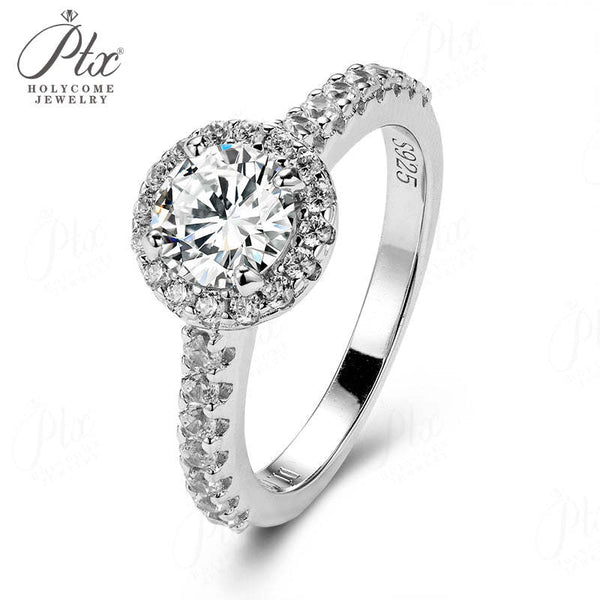
- A halo — a ring of small stones around the centre, adding visual diameter. A 1ct with a halo reads closer to a 1.8ct solitaire.
- A thinner band — a 1.8mm band makes the stone look proportionally bigger than a 3mm band does.
And two make it read smaller:
- Step cuts — emerald and asscher return less light than brilliant cuts, so they look smaller than a round of the same weight.
- Deep settings — a bezel or a high gallery that hides the girdle reduces the visible face.
Where moissanite's doubling shows up
One thing specific to moissanite: above roughly 1.5 to 2 carats, in step cuts especially, double refraction becomes visible as a slight doubling along facet edges under close inspection. Brilliant cuts mask it. This is not a defect, but it is a reason some buyers stop at 1.5ct in emerald or asscher and go larger only in round or oval.
Buying advice, in one line each
- Maximising size for money — 1ct, brilliant cut, thin band, no halo.
- Wanting presence without going huge — 1ct with a halo, or 1.5ct solitaire.
- Wanting the stone to be the point — 2ct solitaire, brilliant cut, size 6 or larger hand.
- Narrow finger, big look — oval or pear at 1.5ct: elongated shapes cover more finger per carat.
- Step cut preference — stay at or below 1.5ct for the doubling, or accept it as character.
The honest summary
If you are deciding purely on value, 1ct is the rational choice and 2ct is an upgrade you make for how it looks, not for efficiency. Both are legitimate. What is not legitimate is paying 2ct prices expecting twice the visual size — the geometry does not work that way.
If you tell us your ring size and what the stone needs to accomplish — everyday wear, an engagement, a statement — we will tell you which carat we would pick and why, including when the smaller stone is the better answer.