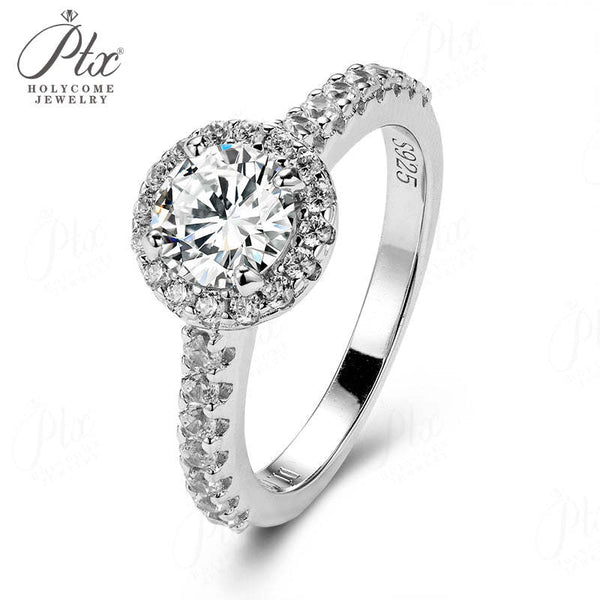
Why a Moissanite Ring Costs a Fraction of a Diamond One
Quick Answer: In our catalogue, moissanite runs 525 pieces at a median of $91.00; lab-grown diamond runs 129 pieces at a median of $221.20. So the stone difference alone is about 2.4x, and it is not the whole story. Most of the visible gap between a $2,000 diamond ring and a $100 moissanite ring comes from the metal — silver at a $103.78 median against K gold at $339.58 — plus the retail chain neither of us carries.

"Cheap" is the wrong word for moissanite, and it is worth disentangling why. A moissanite ring costs less for three separate reasons that stack: the material is grown rather than mined, the material is grown in volume rather than carat by carat, and we sell it direct from the factory that makes it.
Each of those is checkable in our own listings, and each contributes a different amount. Take them one at a time.
Reason One: Silicon Carbide, Grown in a Furnace
Moissanite is silicon carbide. It is created in a furnace from silicon and carbon, and the resulting crystal is cut and polished like any gemstone. Nothing about it is rare in the geological sense — the constraint is the growing process, not supply.
Mined diamond is extracted from kimberlite ore, and the cost of a mined stone includes the volume of rock moved per carat recovered, the sorting, and the decades of supply control that sat on top of both. Lab-grown diamond removes the mining but keeps a step that moissanite does not have: the growth is measured in weeks per stone and the equipment is expensive to run.
Moissanite growth is the cheaper process of the two. That is the first part of the gap, and it is a materials fact rather than a marketing claim.
Reason Two: Volume.
The second reason shows up oddly in our data, and it is the most interesting finding in this cluster. Group our rings by the carat weight in the listing title and the medians barely move.
| Title carat | Rings | Median price |
|---|---|---|
| 0.5ct | 13 | $88.46 |
| 1ct | 79 | $99.18 |
| 2ct | 47 | $103.23 |
| 3ct | 32 | $103.72 |
| 4ct | 10 | $183.50 |
| 5ct | 10 | $127.92 |
From 1ct to 5ct the median rises $28.74 — about 29%. A diamond's price curve is steeper than linear above one carat, because large rough is scarce. Moissanite's curve is close to flat, because large rough is not scarce. That is what volume production does to a price curve.
The 5ct block has 41 listings against 14 at 4ct. A five-carat center is a stocked variant here, not a special order — and the median is lower than the 4ct one. This is the clearest single proof that the constraint on a moissanite ring's price is not the stone.
Reason Three: the Metal Is Doing Most of the Work
Now the part buyers miss. Our 925 silver pieces median $103.78; our 77 K gold pieces median $339.58. That is 3.3x — larger than the 2.4x stone gap between moissanite and lab-grown diamond.
So a $2,000 diamond ring is not expensive because the stone is a diamond. It is expensive because it is a diamond in gold, from a chain with a distributor, a storefront and an inventory carry cost. A $100 moissanite ring is cheap because it is moissanite in silver, sold direct. Both decisions are contributing.
Run the comparison fairly and the picture changes: a moissanite ring in K gold lands near the $339.58 gold median, not near $91.00. The stone is not the whole explanation and buyers who think it is will be surprised at the checkout.
Where the Rest of the Gap Comes From
Two more layers, both structural rather than material.
The chain. We make our pieces in our own factory in Wuzhou and ship them to the buyer. A mined diamond typically passes through a cutter, a wholesaler, a manufacturer, a distributor and a retailer, and each one carries inventory and margin. That is not a criticism of retail — it is a different service — but it is a real part of what a storefront price contains.
Certification and grading cost. A diamond's price is tied to a graded color and clarity, and the grading is part of the product. Our moissanite carries a GRA card and our lab-grown diamond carries an IGI report; both are documented, but the diamond grading step is a heavier process attached to a stone whose value depends on it.
What You Lose, Honestly
Moissanite is not diamond and does not pretend to be. Three real differences.
- Hardness. Diamond is the hardest material; moissanite is close behind but not equal. Both resist daily scratches; neither is indestructible.
- Fire. Moissanite disperses light more strongly, so it shows more colored flashes. Some people prefer it, some find it busy. It is a taste difference, not a quality one.
- Resale. A diamond has a secondhand market, thin as it is. Moissanite has essentially none, and neither does a lab-grown diamond at scale. If resale matters, that is a reason to buy differently, not to buy moissanite.
What You Keep
Everything that shows at arm's length, and one thing that matters more than the price: replacement. A ring you can replace is a ring you can wear without anxiety. At our $91.00 moissanite median, losing a stone is an inconvenience rather than an event.
You also keep the option of size. Because moissanite's price curve is flat, going from a 1ct to a 5ct center costs $28.74 at the median in our catalogue. That is an unusual amount of design freedom for the money.
Why "Cheap" Is the Wrong Frame
Moissanite is cheaper, not cheap. The distinction matters because "cheap" implies something was removed to reach the price, and in the comparison above nothing visible was. The stone is a different material, the metal is a different alloy, and the chain is shorter.
Where a moissanite ring can genuinely be worse is in the setting, and that is a manufacturing decision rather than a material one. A thin shank and four short prongs will fail on any stone. Ask for prong count, shank thickness and whether there is a gallery rail, and the price will tell you whether the savings came from the material or from the build.
Where We Fit
We have been making moissanite since 2008 in our own 8,000㎡ factory in Wuzhou, exporting to more than 100 countries. The moissanite collection holds 525 pieces at a $91.00 median, and the lab-grown diamond collection holds 129 at $221.20 — put side by side, that is the 2.4x stone gap in our own listings rather than someone's estimate.
Shipping is free over $99 and $5.99 below, returns run 30 days, and sales@holycome.com will confirm the certification for any specific piece: GRA for moissanite, IGI for lab-grown diamond.

FAQ
Why is moissanite cheaper than diamond?
Three reasons that stack: silicon carbide is grown rather than mined and costs less to produce, it is grown in volume so larger stones barely cost more, and we sell factory direct. In our catalogue moissanite medians $91.00 against lab-grown diamond at $221.20.
Is moissanite a fake diamond?
No. It is silicon carbide, a different material with its own optical properties, and we sell it as moissanite with a GRA card. A simulated stone is sold as an imitation of something else; moissanite is sold as itself.
Does a bigger moissanite cost much more?
Hardly at all in our listings. The 1ct median is $99.18 and the 5ct median is $127.92 — $28.74 apart, about 29%. Volume growth keeps the price curve close to flat.
Why do some moissanite rings cost $300 or more?
Metal, mostly. Our K gold pieces median $339.58 against $103.78 for silver. A moissanite ring in gold sits near the gold median, not near the stone median of $91.00.
Does moissanite hold up to daily wear?
Yes, and the setting is the part that fails first on any stone. Ask for six prongs above 6mm, a shank thick enough not to flex, and a gallery rail under the girdle.