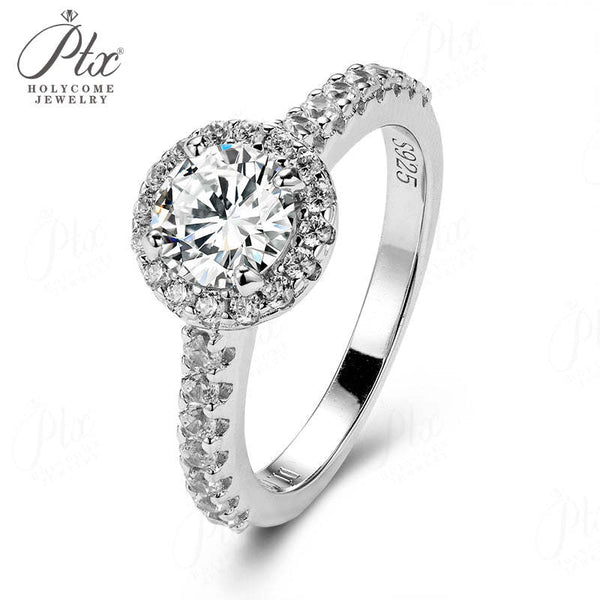
Round vs Oval Moissanite: The Real Price Difference

Quick answer: In our catalogue the median round moissanite piece is $85.88 across 180 designs and the median oval is $99.18 across 57 — a difference of $13.30, or 15.5%. The oval is dearer because an elongated outline wastes more rough and leaves a longer girdle to polish and set, not because the stone is better. The round is the cheaper shape and the better-value one.
Own-catalogue figures, 17 November 2026. All stones are GRA D-colour VVS1 moissanite, hardness 9.25. Medians of retail prices, no competitor data.
Two numbers, one catalogue
| Shape | Pieces | Median | Difference |
| Round brilliant | 180 | $85.88 | — |
| Oval | 57 | $99.18 | +$13.30 (+15.5%) |
Fifteen per cent is a small gap in jewellery terms and a large one in manufacturing terms. Across the nine shapes we sell, medians run from $78.75 to $123.76; round and oval sit in the bottom third and the middle respectively. Neither is a premium shape.
What the $13.30 is not paying for
It is not the stone. Both are the same grade — D colour, VVS1, 9.25 on the Mohs scale — and both are cut from the same material. Carat weight does not explain it either: our medians for whole pieces barely move with size, from $99.18 at 1ct to $103.72 at 3ct, a difference of $4.54 for triple the weight.
Cut loss: the rough decides the shape
A cutter does not choose the outline in the abstract; the rough does. A round brilliant can be cut from a fairly regular crystal with the shape following the material, which is why it has been the default for a century. An oval needs elongated rough, with the ends brought to a curve while the sides stay true — anything cut away to make them symmetrical is material that does not become a stone.
That loss is paid by whoever buys the finished stone. It is also why oval stones vary more than rounds: the same carat weight can produce a short, fat oval or a long, narrow one, and the long ones cost more to make from the same rough.
Perimeter: the cost nobody counts
A piece of geometry that turns directly into money: of all shapes with a given area, a circle has the shortest perimeter. An oval covering the same area — the same carat weight seen from above — has a longer girdle.
A longer girdle means more prong seats to file, more polishing along an edge that must not chip, and a longer thin edge to protect. Four claws on a round sit at even intervals around a constant curve; four claws on an oval sit on two tight ends and two flat sides, each seat a different shape. That is bench time, and bench time separates $85.88 from $99.18.
The bow-tie, and why it is not a defect
Ovals show a dark band across the middle when the light is wrong — the bow-tie — because the pavilion facets at the ends reflect light back at a different angle to those along the sides. Every elongated cut does it to some degree; in a good oval it is shallow and even. Cutting that out is one more reason a well-cut oval costs more.
The oval premium against other moves
| Move | Median change | Verdict |
| 1ct → 3ct centre | +$4.54 | Cheapest upgrade in the catalogue |
| Oval → marquise | +$1.59 | Almost free, very different on the hand |
| Round → oval | +$13.30 | The outline premium |
| Round → cushion | +$37.88 | Most expensive outline we sell |
| 925 → 14K gold | +$86.35 | Six times the oval premium |
Read down that column and the priorities sort themselves. Size is nearly free, shape costs a little, metal costs a great deal. If the budget is fixed at around $99, the choice is between an oval at the median and a round three carats up at $103.72 — a meaningfully bigger stone in a cheaper shape.
Same budget, three routes
Buy the oval. You want the elongated look, you accept the $13.30, and you get a stone that covers more finger than a round. Right answer if the outline is the whole point.
Buy the round and go bigger. The same money buys more carat in round than in any other shape, because you are not paying the outline premium or the cutting loss. On a hand, a round two sizes up usually reads as more stone than a slimmer oval.
Buy the round and move shape sideways. Marquise is $100.77, gives you the elongated look for $1.59 more than oval, and needs a wider setting to protect two sharp points.
Which one to choose
Choose on the finger, not the spreadsheet. The elongation makes a smaller stone read larger, which is the honest case for paying the 15.5%. Rounds are the most forgiving in low light, the easiest to reset later, and the cheapest per carat.
What not to do is pay the premium for a badly cut one. A round cannot have a wide bow-tie; an oval can. Ask for a straight-on daylight photograph first.
FAQ
Why is an oval moissanite more expensive than a round?
Two reasons. An elongated outline wastes more rough, and an oval of the same carat weight has a longer girdle — more prong seats, more polishing. Both land on the price.
Is 15.5% a normal premium for oval?
In our catalogue it is exactly what the two medians say: $85.88 against $99.18. We do not publish competitor prices, so treat it as a fact about our range rather than an industry norm.
Does an oval look bigger than a round of the same carat?
It covers more length but less width, and most people read the length — so an oval looks larger on the hand at the same weight. That is the practical argument for the premium.
Which holds its value better?
Neither, at these prices. A moissanite is not an investment; the value is in the wearing. If resale matters, the metal matters far more than the shape: 14K gold costs $86.35 more than silver at the median and keeps material value that a stone does not.
What we make
We cut, cast and finish in our own factory in Guangxi, which we have run since 2008, in 925 sterling silver, 9K, 14K and 18K gold, and PT950 platinum. Every stone is GRA-certified D-colour VVS1 moissanite at 9.25 on the Mohs scale, or IGI-certified lab-grown diamond, and every listing states the shape, the setting and the metal in plain terms.
Shipping is free over $99 and $5.99 below it. Returns run 30 days on unworn pieces in original packaging, excluding custom and engraved work. If you are torn between round and oval, that window is the cheapest way to settle it: wear one for a week and look at it in bad light.