Platinum vs White Gold: Which One Actually Lasts

They look similar in a photograph and behave nothing alike over a decade of wear. The difference is not colour — it is what happens to the metal when it is rubbed.
Two white metals, two failure modes
White gold is plated. The white surface is a coating, and coatings run out. Platinum is not plated: the white surface is the metal itself, and it does not change colour. Everything else — price, maintenance, weight — follows from those two sentences.
Density: why platinum feels heavier
Platinum has a density of about 21.4 grams per cubic centimetre. A 14K white gold alloy sits around 12.5 to 13.5, depending on the whitening metals. That is well over half again in the hand.
People call this "denser," which is right and slightly misleading. It is not stronger — it is heavier for the same volume, so a 2mm platinum band weighs half again as much as a 2mm 14K band. That weight is much of the price.
| Property | Platinum (PT950) | 14K white gold |
| Density | ~20.5–21.0 g/cm³ | ~12.5–13.5 g/cm³ |
| Plating | None — ever | Rhodium, every 1–3 years |
| Wear | Metal displaced, not lost | Metal lost as dust |
| Over time | Grey patina, polishes bright | Yellow tint as plating fails |
Platinum has no coating to wear off
A platinum ring worn for twenty years is still platinum all the way through. There is no layer to lose, so there is no moment when the colour turns. Platinum does develop a patina — a soft grey sheen — which many people prefer. If you do not, a jeweller can polish it bright in minutes, removing almost nothing.
White gold is plated, and the plating is the maintenance
A white gold ring arrives bright because it has been rhodium plated. That coating wears through at contact points first: the inside of the band, the prong tips, the setting edges. When it goes, the alloy shows — pale yellow on gold, grey on silver.
Re-plating is routine and cheap, but it recurs: over ten years of daily wear a white gold ring will be re-plated several times.
Displacement versus loss
This distinction is worth getting exactly right.
When platinum wears, the metal is pushed. A platinum ring develops a burnished surface where metal has been displaced from high spots into low ones. Almost none of it leaves, which is why a platinum ring can be restored: the material is still there, and a jeweller can move it back.
When white gold wears, the metal is removed: abrasion lifts particles away as dust. The ring gets thinner permanently, and no polish brings back metal that is gone.
Prongs: where the difference shows first
Prongs take every impact. In white gold they are the first thing to lose plating and the first to wear thin enough to need re-tipping.
Platinum prongs hold shape far longer, and when they wear, the displaced metal tends to push over the stone rather than retreat from it. A platinum prong at ten years is often still functional; a white gold one of the same age may have been re-tipped twice. For a large centre stone, that is the argument that matters.
What PT950 actually means
PT950 is a purity stamp: 95% platinum, 5% other platinum-group metals — usually ruthenium, iridium or cobalt — added for workability. Pure platinum is soft and hard to cast cleanly, so essentially all platinum jewelry is alloyed.
You will also see PT900, and rarely PT850; the practical difference is small. The stamp to be suspicious of is a bare "PLAT" with no number, or "platinum" in a description with nothing stamped on the piece.
The price gap, in real terms
Platinum costs more per gram than gold, and a platinum piece uses more grams for the same dimensions because of the density. Those multipliers compound: the same design in PT950 can cost two to three times what it costs in 14K white gold. Worn daily for decades, the premium buys no re-plating, no metal loss and prongs that need no rebuilding. Worn occasionally, you are paying for durability you will never use.
Matching the metal to how you wear it
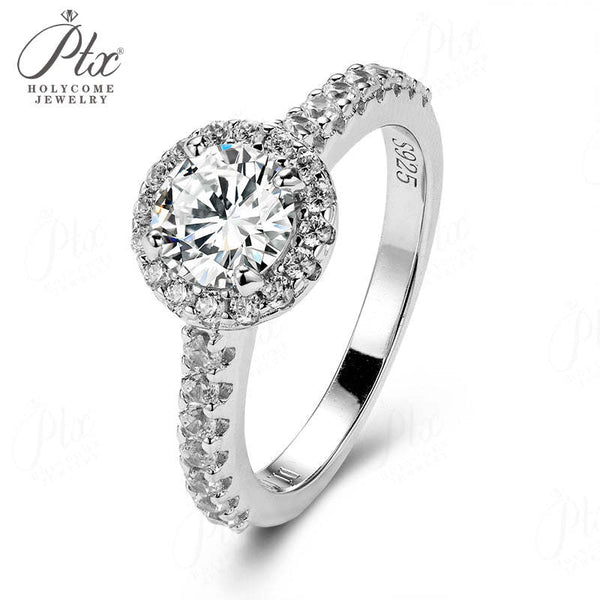
- Wedding or engagement ring, worn constantly — platinum. Maintenance-free is worth the price when the piece never comes off.
- Fashion ring, rotated — 14K white gold. Less wear, so plating lasts years and the saving buys a second piece.
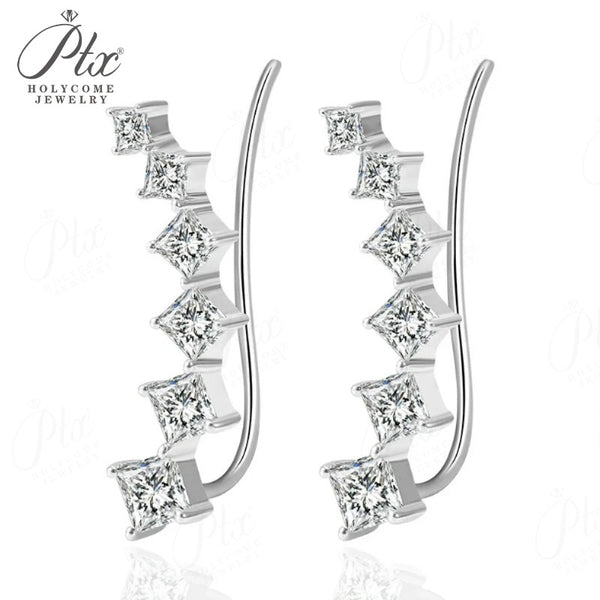
- Pendant or earrings — white gold. Nothing rubs, so plating lasts, and platinum's weight is a disadvantage on an earlobe.
- Chain bracelet — white gold. Platinum bracelets are heavy and costly for a piece that takes less abrasion than a ring.
Why rings are platinum and earrings are not
Platinum dominates bridal rings and barely appears in earrings. That is not snobbery, it is physics plus economics.
A ring is the only common piece worn against a hard surface continuously — palm, keyboard, steering wheel, door handle. Abrasion is constant, which is exactly when platinum's displacement behaviour matters. An earring hangs in air: nothing rubs, so the durability premium buys nothing, and the density that makes a ring feel substantial makes an earring droop.
What we make
Our range covers 925 sterling silver, 9K, 14K and 18K gold, plus platinum on request for bridal pieces. We do not plate platinum, because there is nothing to plate it with that would improve it — the metal is already the finish.
Our factory in Wuzhou, Guangxi has been cutting and setting since 2008, and our moissanite is D colour VVS1 with a GRA certificate. Prices run $17 to $2,020, median about $98. Free shipping over $99; $5.99 below. Returns within 30 days on unworn pieces in original packaging.