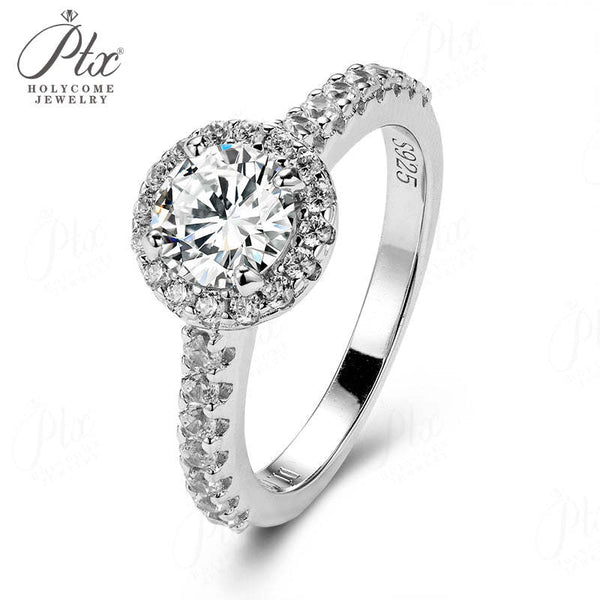
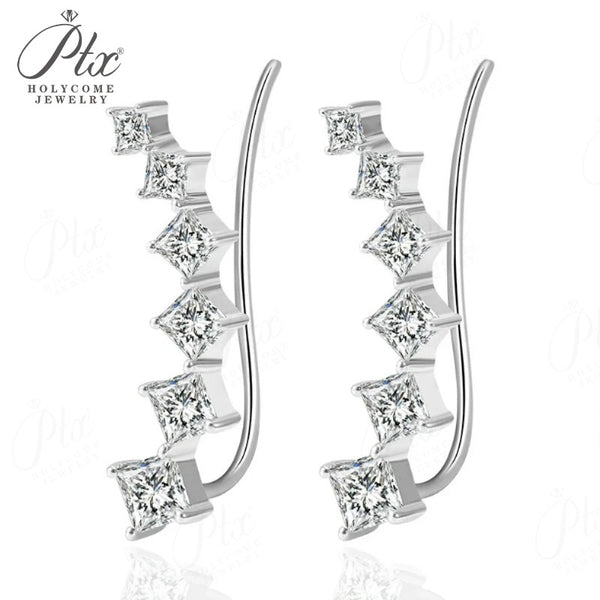
Moissanite vs Lab Grown Diamond: What's Actually Different
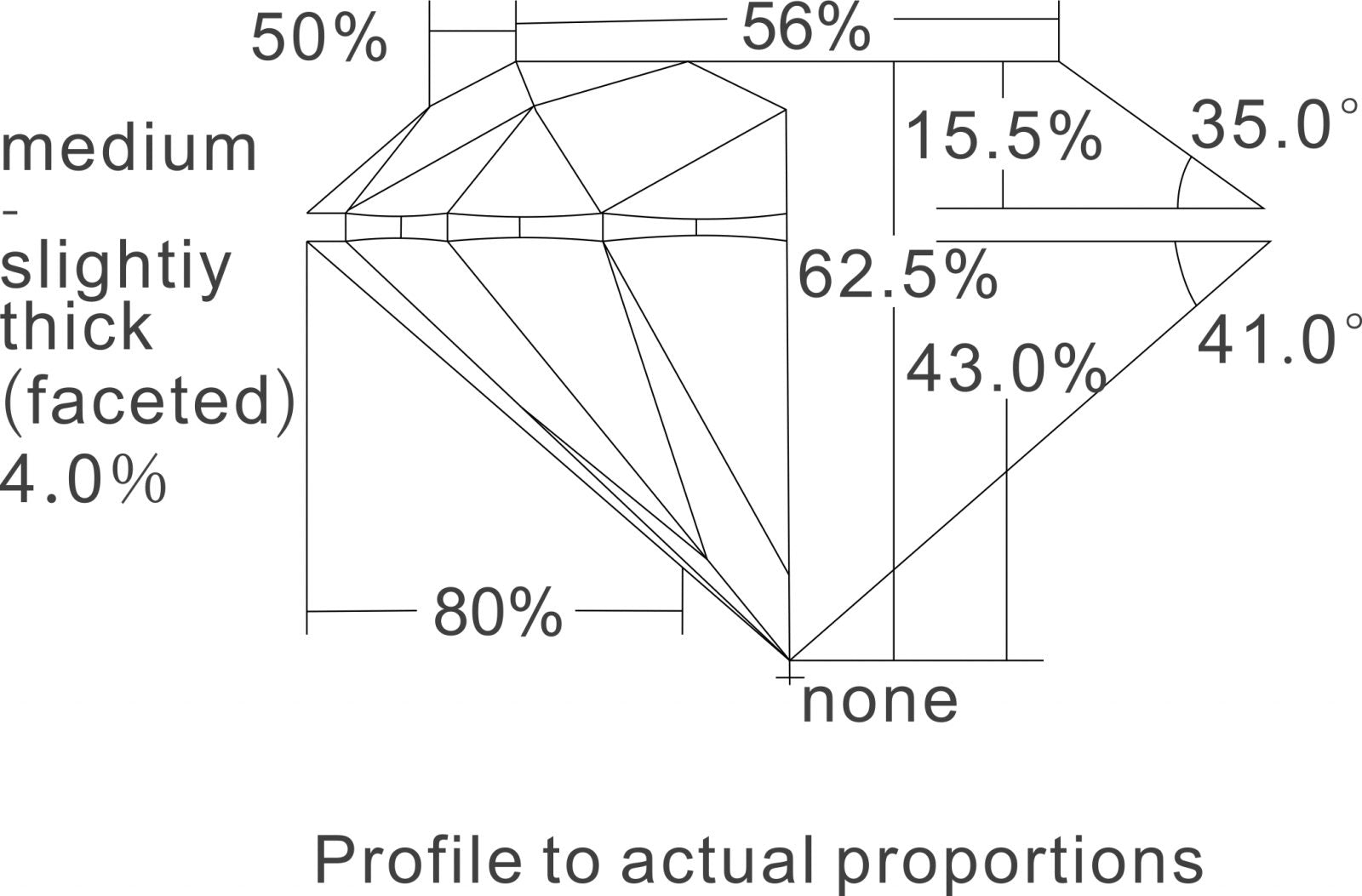
Cut proportions determine how much light returns to the eye, regardless of stone type. Moissanite and lab grown diamond look almost identical in a photograph and completely different under a loupe. They are not the same material, they are not graded the same way, and they do not cost the same. If you are choosing between them for an engagement ring, the decision comes down to four things: what the stone is made of, how it handles daily wear, how it looks in person, and what the certificate actually tells you.
This is what we tell customers who ask us directly, having made both for eighteen years.
The one-sentence version
Moissanite is silicon carbide grown in a lab; lab grown diamond is carbon grown in a lab. Both are real stones with real optical properties. Moissanite has more fire and costs roughly a tenth of what a lab grown diamond of the same size costs; lab grown diamond is harder, is graded the same way mined diamond is, and reads as a diamond to anyone who looks.
What each one actually is
Moissanite
Silicon carbide. It was first identified in a meteor crater in 1893 and has been grown commercially since the 1990s. It is not a diamond simulant in the way cubic zirconia is — it does not try to imitate diamond's chemistry, and it does not degrade over time the way CZ clouds and scratches. It is its own material with its own properties.
Lab grown diamond
Carbon, crystallised under the same conditions that produce a mined diamond — either high pressure high temperature (HPHT) or chemical vapour deposition (CVD). The result is chemically, physically and optically a diamond. A gemologist cannot tell a lab grown diamond from a mined one without an instrument that reads trace nitrogen or growth patterns. The difference is origin, not substance.
Hardness: 9.25 vs 10 on the Mohs scale
Diamond is the hardest natural material at 10. Moissanite sits at 9.25. That gap sounds small and is, in practice: moissanite does not scratch from normal wear, and it will not abrade against fabric, metal or skin. What it does mean is that a moissanite will show wear sooner than a diamond if it is knocked hard against stone or concrete, and that a diamond can be re-polished indefinitely while moissanite can be re-polished a limited number of times.
For an engagement ring worn daily, both are more than adequate. The realistic failure mode for either stone is the setting, not the stone — a prong that works loose and lets the stone drop out. That is why we inspect every setting before packing, and why we tell customers to have prongs checked once a year.
Brilliance, fire, and the double refraction issue
This is where the two diverge visually, and where most online comparisons get it wrong.
Moissanite has a refractive index of 2.65 to 2.69. Diamond is 2.42. A higher refractive index means more light is bent back to the eye, which is why moissanite looks brighter and throws more coloured flashes — the "fire" — than diamond does. Some people love this. Some people find it reads as slightly disco under strong light.
Moissanite is also doubly refractive, meaning light splits into two paths as it passes through the stone. In larger stones, this can produce a slight haziness or doubling of the facet edges when you look closely. Diamond is singly refractive and stays crisp at any size. Under 1.5 carats, most people cannot see the difference without knowing to look for it. Above 2 carats, a trained eye can.
Neither is better. It comes down to whether you want maximum sparkle or maximum crispness.
Colour and clarity: graded differently
Lab grown diamonds are graded on the same scale as mined diamonds — D through Z for colour, FL through I3 for clarity. Most of our lab grown stock is D colour, VVS1 clarity, certified by IGI. The certificate states the specific grade of the specific stone; check the variant you are ordering rather than assuming the page default.
Moissanite is not graded on the diamond scale, because the scale does not apply to it. Moissanite is typically described as colourless to near-colourless, and the trade grades it loosely as D-E-F equivalent. It does not have the inclusion types diamonds have, so clarity grading is largely irrelevant. What matters for moissanite is cut quality and how closely two stones in the same piece match.
This is an important point that gets glossed over: a moissanite certificate is not a diamond certificate. GRA documents moissanite. IGI documents diamond. If a seller offers a "GIA certified moissanite", that is a red flag — GIA does not grade moissanite.
Price: roughly a tenth, and why
Lab grown diamonds have fallen in price sharply over the last five years as production scaled, but they are still priced against mined diamond benchmarks. A lab grown diamond of a given size, colour and clarity typically runs a fraction of the mined equivalent — and moissanite typically runs roughly a tenth of the lab grown price for the same visual size.
The gap is not a quality gap. It is a supply gap. Silicon carbide is cheap to grow and grows fast; diamond growth is slower and more expensive per carat. You are not buying "less stone" with moissanite, you are buying a different material at a different production cost.
Certification: GRA vs IGI
GRA (Global Gemological Research Academy) issues moissanite certificates. It states the stone type, dimensions and a colour grade. It is not the same tier of authority as GIA or IGI, and it is not meant to be — moissanite does not require the same grading depth.
IGI (International Gemological Institute) issues lab grown diamond certificates and is one of the two major labs recognised for lab grown grading (the other being GIA). An IGI certificate for a lab grown diamond states carat weight, colour, clarity, cut, polish, symmetry, fluorescence and the growth method (CVD or HPTP), plus a laser inscription on the girdle that matches the certificate number.
Both certificates ship with the piece, not by email. If you are buying a lab grown diamond over about 1 carat, insist on the certificate being physically in the box.
How to actually decide
Choose moissanite if: you want the largest possible visual stone for the budget, you like high fire, you are under about 1.5 carats where double refraction is invisible, and you are comfortable with a material that is not diamond.
Choose lab grown diamond if: you want a stone that is chemically diamond, you want a certificate graded on the diamond scale, you are buying 2 carats or larger where moissanite's doubling becomes visible, or the recipient specifically wants a diamond.
Choose 925 sterling silver for either if: the piece is for occasional wear. Choose solid 9K, 14K or 18K gold if it will be worn daily for years — a silver setting will need re-plating eventually, gold will not.
Both are made in our own workshop in Wuzhou. Both ship with the certificate matched to the specific piece. Both can be returned within 30 days in unworn condition.