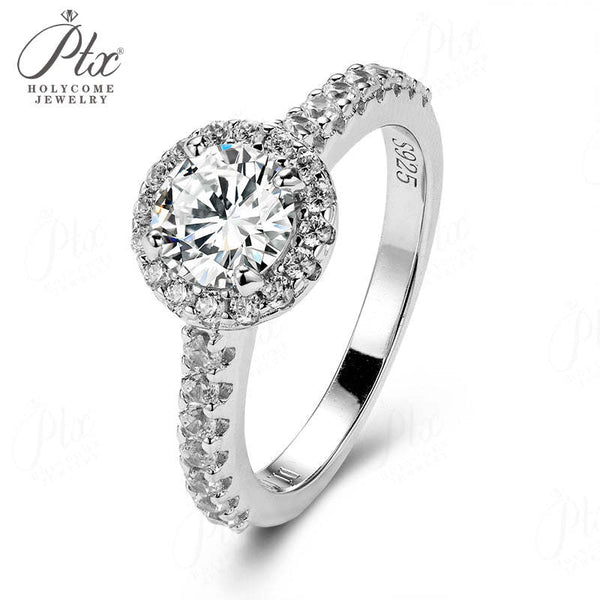
Moissanite Ring Cost by Carat: 181 Rings, Measured

Quick answer: Carat weight barely moves the price of a moissanite ring. In our catalogue the median 1.0ct ring costs $99.18, the median 2.0ct ring $103.23 and the median 3.0ct ring $103.72 — 4.6% more money for three times the stone. The only real step comes at 4ct, where the median rises to $183.50.
These are not market averages or estimates. They are the listed prices of 181 moissanite rings in our own store, measured on 17 November 2026, with the median and interquartile range for each carat band.
What we measured, and why medians
The sample is 181 rings — every ring listing on the site that day, across a catalogue that runs from $13.02 to $6,260.80. For each carat band we took the median, not the mean, because a single exceptional piece distorts an average badly in a catalogue this wide. We also took the interquartile range, which is the middle half of prices and the honest measure of what most pieces actually cost.
Across the whole catalogue the ring median is $94.49, with an interquartile range of $72.56 to $164.91.
The carat table
| Carat weight | Listings | Median price | Change from band below |
| 0.5ct | 13 | $88.46 | — |
| 1.0ct | 75 | $99.18 | +$10.72 |
| 2.0ct | 47 | $103.23 | +$4.05 |
| 3.0ct | 28 | $103.72 | +$0.49 |
| 4.0ct | 10 | $183.50 | +$79.78 |
Read the third column downwards and the pattern is almost flat until the last line. Doubling from 1ct to 2ct adds $4.05. Adding a third carat adds 49 cents. Then the fourth carat adds $79.78 in one move, which is more than the entire climb from half a carat to three.
Why three carats cost four dollars more
Moissanite is silicon carbide grown in a laboratory, and the cost of the rough is a small part of the cost of the ring. What you pay for is cutting, setting, metal and finishing — work that does not multiply when the stone grows. A 3ct blank takes longer in the reactor than a 1ct blank, but the difference is measured in hours of furnace time, not in scarcity.
Diamond pricing runs the other way. Price per carat rises steeply with size because large rough is genuinely rare, so a 3ct diamond costs far more than three 1ct diamonds of the same grade. That is the single biggest reason a moissanite ring and a diamond ring at the same size behave so differently: one price list is driven by rarity, the other by labour and metal.
What actually moves the price
| Metal | Listings | Median price | Multiple of 925 silver |
| 925 sterling silver | 480 | $97.11 | 1.0× |
| 14K gold | 7 | $183.46 | 1.9× |
| 18K gold | 59 | $345.80 | 3.6× |
| PT950 platinum | 3 | $561.47 | 5.8× |
Metal is where the money is. Moving a ring from silver to 18K gold multiplies the median by 3.6; moving it from 1ct to 3ct multiplies the stone by three and adds 4.6% to the bill. If you want a bigger ring rather than a richer one, the catalogue will sell you the bigger ring almost for free and charge you properly for the gold.
Carat in millimetres
Weight is volume, so diameter grows more slowly than the number on the card. A round brilliant at 0.5ct measures about 5.0mm across, 1ct about 6.5mm, 2ct about 8.2mm, 3ct about 9.3mm and 4ct about 10.4mm. Going from 1ct to 3ct is a 43% increase in width, not 200% — which is why a 3ct stone reads as "noticeably larger" rather than "three times larger", and why the four dollars is such a strange bargain on paper.
Where the money should go instead
Since size is nearly free at the margin, spend the difference on the parts that fail. Prong thickness and a reinforced shank matter more than a quarter-carat either way. A well-cut stone matters more than a marginally larger one. And the alloy should match the hand: 925 silver is fine for a ring worn a few days a week and will tarnish with chlorine and perfume; 14K and 18K wear better daily; 9K is the hardest of the golds and the palest in colour.
The one thing worth refusing is a heavy setting used to justify a price. Weight in the mount is not quality. A ring that sits low, holds the stone at four well-formed prongs and has metal where the finger bends will outlast a heavier ring that does not.
FAQ
Is a 3ct moissanite ring worth the extra over 1ct?
At our medians, yes — it is $4.54 more. The caveat is that 3ct pieces are more often set in gold, so the ring you actually compare may cost $200 more for reasons that have nothing to do with the stone.
Why is there no price jump between 1ct and 3ct?
Because moissanite is grown, not mined. The rough for a 3ct stone costs little more than the rough for a 1ct stone, and the setting, labour and finishing are nearly identical. The price tracks work, and the work does not triple.
Does a large moissanite look obviously fake?
Size is not what gives a stone away; proportion is. A 9mm stone in a band that is too thin for it looks wrong whatever the material. Set at a sensible height in metal with enough presence, a D colour VVS1 moissanite reads as a large clean stone and nothing more.
What does a 1ct moissanite ring cost in gold?
Metal sets the tier, not carat. Our medians are $97.11 in 925 silver, $183.46 in 14K, $345.80 in 18K and $561.47 in PT950 — so a 1ct ring in 18K typically lands near the 3ct silver price plus the gold premium, not at three times it.
What we make
We have run our own factory in Guangxi since 2008, cutting and setting GRA D colour VVS1 moissanite in 925 sterling silver, 9K, 14K and 18K gold, alongside IGI-certified laboratory-grown diamond. Because the rings are made rather than bought in, a carat costs what a carat costs us — a few dollars of rough — instead of what a rarity curve says it should.
Prices across the catalogue run from $13.02 to $6,260.80, with a median of $95.42. Shipping is free over $99 and $5.99 below it, and unworn pieces in their original packaging can be returned within 30 days, though engraved and custom work cannot. If two sizes are within five dollars of each other, buy the one you would rather look at.