Moissanite Hardness 9.25: What It Actually Means Day to Day

9.25 on the Mohs scale sounds like second place. In daily wear it is not — because almost nothing you touch in a normal week is hard enough to mark it. The damage that actually happens to moissanite rings comes from impact, not abrasion.
What the Mohs number actually measures
Mohs is a scratch test, and only a scratch test. It ranks materials by whether one can cut into another, on an ordinal scale from 1 (talc) to 10 (diamond). It says nothing about how a stone behaves under a hammer, how it handles heat, or how it survives being knocked against a door frame. Those are separate properties, and for jewellery they matter at least as much.
So when you read "9.25", translate it precisely: moissanite will not be scratched by anything softer than itself — which is almost everything.
9.25 against diamond's 10
Diamond is the only gem material harder than moissanite. Between 9.25 and 10 there is nothing else you will encounter — sapphire and ruby sit at 9, topaz at 8, quartz at 7, steel around 5 to 6.5, glass around 5.5. That gap of 0.75 looks small on paper and is, in practice, the difference between two members of the same elite tier rather than a difference between good and fragile.
The real-world consequence is narrow and specific: a diamond can scratch a moissanite, and a moissanite cannot scratch a diamond. Everything else that scratches one scratches neither.
What can actually scratch it
Three things, realistically. Loose diamond melee in the same jewellery box. Diamond grit embedded in a polishing cloth or an old toothbrush that has been used on diamond jewellery. And another moissanite, at enough pressure and angle. That is close to the complete list for normal life.
Note what is not on it: granite and quartz countertops, ceramic tile, steel tools, concrete, sand, keys, the inside of a handbag. All are softer than 9.25 and at most leave metal transfer — a grey smear that polishes off, not a scratch.
Chipping is the risk that matters
Hard materials resist being cut; tough materials resist breaking. Moissanite is very hard and moderately brittle. That combination means the failure mode you should expect is not a dull, scratched facet — it is a small chip or a crack at an edge under a sharp blow.
A flat blow across the table is usually harmless; a glancing impact on a thin edge is not. Cut matters more than the hardness number for a ring you will wear hard.
Where damage shows up on a real ring
The crown, not the pavilion. Chips appear at the girdle — the thin rim where the top and bottom of the stone meet — and at facet junctions on the crown, especially on stones with pointed ends or sharp corners. Marquise, pear, heart and princess cuts concentrate stress at their tips and corners, and a thin girdle on any of those is the most common place a stone fails.
On a round brilliant with a properly cut girdle, a chip in normal wear is uncommon. On a marquise with an extremely thin girdle, a knock against a car door is enough. Same material, different risk.
What each everyday encounter does
| Contact | Rough hardness | Effect on moissanite |
| Quartz countertop | 7 | No scratch; possible chip on impact |
| Steel tool or key | 5–6.5 | Metal smear only, polishes off |
| Sapphire or ruby | 9 | No scratch |
| Diamond melee | 10 | Will scratch if rubbed hard |
| A hard knock on an edge | — | Chip or crack at girdle or tip |
Ring, earring, pendant
A ring on your dominant hand takes more abuse in a month than a pendant takes in a decade. Studs and pendants sit against skin or fabric and essentially never chip. Bangles and tennis bracelets sit in the middle: metals clink, stones rarely touch anything hard.
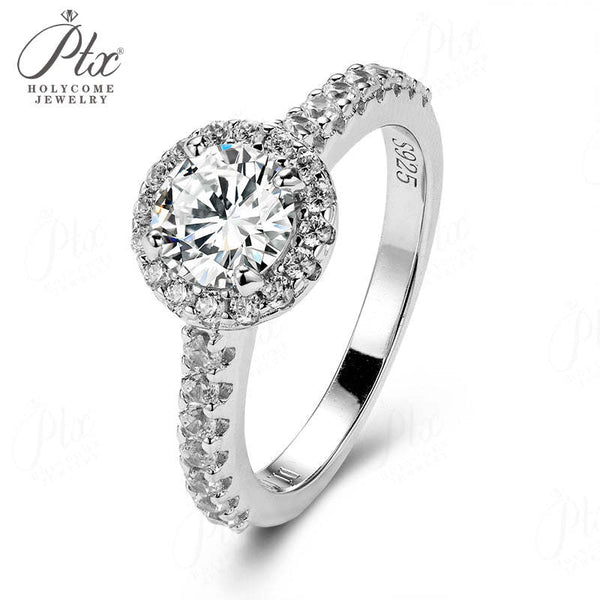
So the honest answer to "is 9.25 hard enough" depends on the piece. For earrings and pendants the question is academic. For a daily-wear ring it is adequate, but cut and setting matter more than the grade: a low-set round stone in a bezel or a protective halo is far safer than a high-set marquise with exposed points.
Care that actually helps
Store moissanite separately from diamond pieces — a fabric pouch per piece solves it. Skip abrasive pastes and old toothbrushes that have been used on diamond jewellery, since grit can transfer. Warm water, mild soap and a soft brush restore the sparkle, and an ultrasonic cleaner is fine for moissanite itself as long as the setting is not glued or fragile. Have prongs checked once a year; a loose prong is what turns a small chip into a lost stone.
What you do not need to worry about is the slow dulling that plagues cubic zirconia. CZ at hardness 8–8.5 abrades against ordinary grit and clouds over time. Moissanite does not do that. Its polish holds, which is the practical reason the 0.75 gap matters less than the number suggests.
What we make
Our factory in Guangxi has been cutting and setting since 2008. Our moissanite is GRA D colour, VVS1, at 9.25 hardness, mounted in 925 sterling silver, 9K, 14K or 18K gold. Where a design has an exposed point or a thin girdle we say so, because that is the part of a ring that fails first — not the stone's hardness grade.
Prices run $17 to $2,020, median around $98. Free shipping over $99, otherwise $5.99, and 30-day returns on unworn pieces in their original packaging if the cut or the size is not right in person.