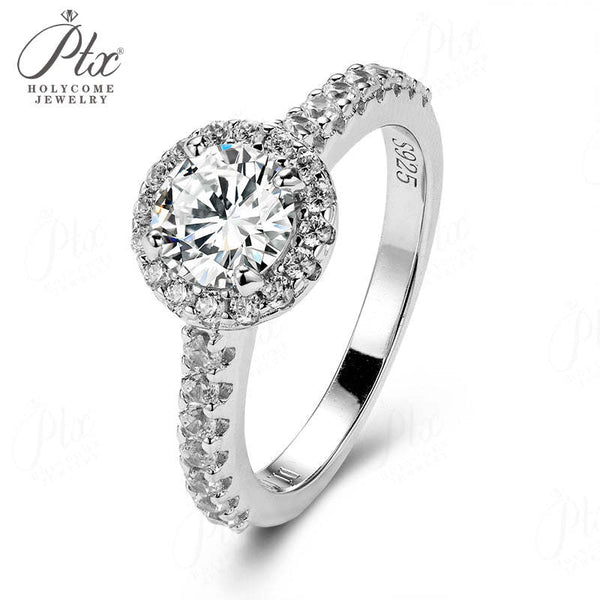
Moissanite in Sunlight: Why It Glows

Quick Answer
Moissanite does not fluoresce in sunlight — it disperses. Its high dispersion splits white light into its component colours, which you see as rainbow flashes. Indoors under diffuse light this effect nearly disappears, which is why the same stone can look calm at a desk and vivid outdoors.
Dispersion vs fluorescence
| Dispersion (moissanite) | Fluorescence (some diamonds) | |
|---|---|---|
| Cause | Light bends at different angles by wavelength | UV light excites the stone, which re-emits visible light |
| Looks like | Rainbow flashes — red, orange, green, blue | A soft overall glow, usually blue |
| Trigger | Any strong directional white light | Ultraviolet, e.g. sunlight or a blacklight |
| In shade | Reduces sharply | Reduces sharply |
The confusion is common because both effects are strongest in sunlight. But dispersion is an optical geometry effect and fluorescence is an energy conversion effect — different physics, different look.
Why moissanite shows more fire than diamond
Dispersion is measured by how much a material separates wavelengths. Moissanite's figure is higher than diamond's, so its rainbow effect is stronger. Diamond returns more white light — brilliance — while moissanite throws more colour — fire.
Neither is a defect. It is the same trade-off as a prism versus a mirror.
When it reads as "too much"
In large stones under direct sun, the fire can be strong enough to read as colourful rather than white. Buyers who want a diamond-like look sometimes find a 3ct moissanite outdoors more vivid than expected. Smaller stones show less of it, and step cuts (emerald, asscher) show almost none because their large flat facets do not split light the same way.
If you want maximum rainbow, a round brilliant is the shape. If you want a calmer look, a step cut in moissanite reads closer to a diamond.
Does it fade or change over time?
No. Moissanite does not fade, cloud, or change colour with light exposure. What dulls it is surface dirt and oil, which is why a clean stone looks dramatically brighter than a dirty one of the same grade.
What you see in different lighting
| Lighting | What moissanite does | What diamond does |
|---|---|---|
| Direct sunlight | Strong rainbow flashes | White brilliance, less colour |
| Diffuse daylight | Mild fire, bright body | Bright, clean white return |
| Indoor tungsten | Warm, fire reduced | Warm, still bright |
| Fluorescent office | Flat, low fire | Flat, low fire |
| Spotlight / display | Dramatic fire | Dramatic brilliance |
Because jewellery is usually bought under spotlights, the stone you see in the shop is not what you will see at your desk. Judge a moissanite in daylight if you can.
Why cut shape changes the fire
A round brilliant has many angled facets that split light into colour. A step cut — emerald or asscher — has large flat facets arranged in steps, which reflect light back rather than dispersing it. The result is a calmer, glassier look with almost no rainbow.
If you like the diamond look but want moissanite's price, a step cut is the closest match. If you want maximum sparkle, round brilliant is the answer.
Cleaning and apparent brightness
Any stone looks dull when dirty. Skin oil on the pavilion (the underside) kills light return, and moissanite's fire suffers more visibly than its brilliance. A quick wash with mild soap and a soft brush restores it completely.
If your moissanite looks flat, clean it before concluding anything about the stone.
Why photographs look more dramatic than real life
Product photography uses directional light to maximise fire, because fire is what sells a stone. In a room lit evenly, the same stone shows far less colour. Buyers who expect the photograph are surprised by the stone in a normal room.
This is true of every gemstone, not just moissanite. But moissanite's high dispersion makes the gap wider than most, because it has more fire to lose.
Cleaning, and why it matters more here
Fire depends on light entering and leaving through clean facets. Skin oil on the pavilion scatters light before it can disperse, so a dirty moissanite loses its colour play first and its brightness second. A quick wash restores both.
If a stone looks flat, clean it before deciding anything about it. That advice applies to every gem, and it is the most common false alarm in jewellery.
Does the setting change the fire?
Yes, in two ways. An open setting lets light in from below, which increases dispersion. A closed or bezel setting blocks that path, which calms the stone — some buyers prefer this because it looks closer to a diamond.
If you like the moissanite look but find it too colourful, a bezel is a practical way to tone it down without changing the stone.
Buying sight unseen
If you cannot see the stone in daylight before buying, ask for a video shot near a window rather than under a lamp. A daylight video shows what the piece actually looks like in the conditions you will wear it, and it is the only reliable substitute for holding it yourself.
Ask for a clean stone in the video. A dirty moissanite reads flat regardless of its quality, and that misleads buyers in both directions.

FAQ
Does moissanite glow under UV?
Rarely, and not consistently. The rainbow effect in sunlight is dispersion, not fluorescence.
Why does my moissanite look dull indoors?
Dispersion needs strong directional light. Indoors, with diffuse light, the fire is much less visible. Clean the stone first.
Which shape shows the most fire?
Round brilliant. Step cuts — emerald and asscher — show the least.
Is strong fire a sign of a fake?
No. It is the expected behaviour of moissanite.
Can I make it look more diamond-like?
Choose a step cut, or a smaller stone. Both reduce the visible fire.