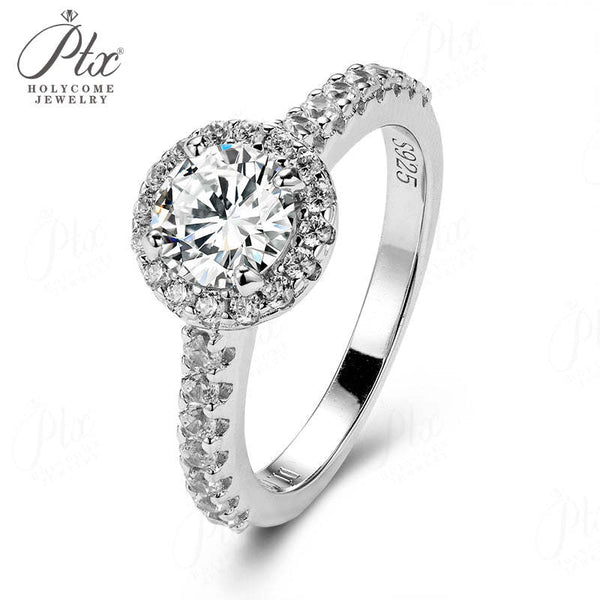
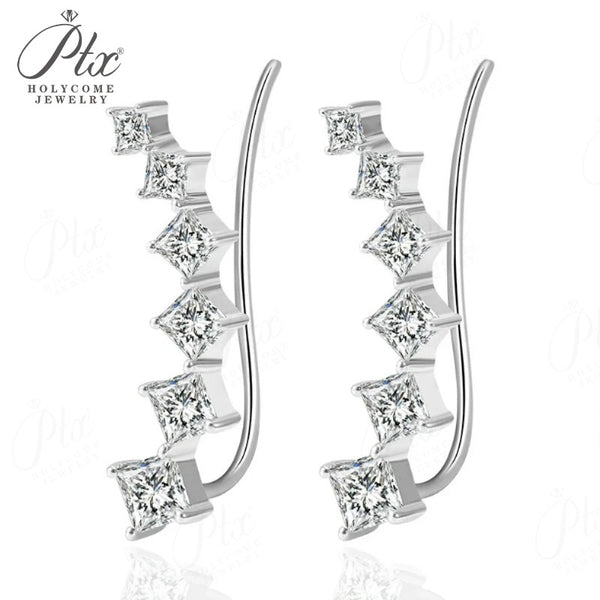
Diamond Alternatives Compared: Moissanite, Lab Diamond, CZ, White Sapphire

Moissanite, lab grown diamond, cubic zirconia and white sapphire all photograph as a white stone. Once you know what each one is made of, the choice stops being about appearance and becomes a straightforward trade between fire, durability and money.
Four materials, four different answers
These stones are not grades of the same thing. Moissanite is silicon carbide. A lab grown diamond is carbon, grown in a reactor. Cubic zirconia is zirconium dioxide, grown in a furnace. White sapphire is corundum — aluminium oxide — the same mineral family as blue sapphire, just colourless. Different chemistry means different hardness, different optics, and a different lifespan in a ring.
Below is the comparison we would want if we were buying, followed by the one weakness that actually matters for each.
The comparison table
| Property | Moissanite | Lab diamond | CZ | White sapphire |
| Chemistry | Silicon carbide | Carbon | Zirconium dioxide | Aluminium oxide |
| Mohs hardness | 9.25 | 10 | 8–8.5 | 9 |
| Fire (dispersion) | Highest of the four | High, white-led | Moderate, glassy | Low, flat |
| Optical behaviour | Birefringent, facets double | Single refraction | Single refraction | Single refraction |
| Relative price | Low | Highest | Lowest | Low to mid |
| Certificate | GRA card | IGI report | None standard | None standard |
| Best for | Daily wear, maximum sparkle | Diamond optics, milestone pieces | Occasional or costume wear | Understated, durable, low-key |
Moissanite: the fire leader
Nothing else at this price throws colour the way moissanite does. Its birefringence splits light inside the stone and pushes dispersion higher than diamond's, so a moissanite ring reads as brighter across a room. At 9.25 on Mohs it is harder than everything on this list except diamond, which makes it genuinely suitable for a ring worn every day.
Its weakness is not durability. It is colour consistency at the top of the scale. Truly colourless moissanite — a D colour grade — is harder to produce at volume than a near-colourless stone, so supply tightens and price steps up as you climb towards D. Buyers who cannot see the difference between a D and an H are paying for a grade rather than an appearance. Ours is graded GRA D colour, VVS1, so the top of the scale is what ships.
Lab grown diamond: the actual diamond
A lab diamond is a diamond. Carbon lattice, hardness 10, single refraction, IGI grading. If the requirement is "must be a diamond", this is the only entry on the list that satisfies it, and it costs a fraction of a mined stone because it is manufactured rather than extracted.
Its weakness is the price of that word. You pay a large premium over moissanite for optics that, in a side-by-side under shop lighting, are not obviously better — arguably less fiery. You are buying the material's name and its paperwork. That can be the right purchase, but choose the premium deliberately.
Cubic zirconia: cheap, and it shows
CZ is grown in a furnace and it is the cheapest colourless stone you can set. Fresh out of the box it looks convincing in a photo; in the hand it looks glassy, because its dispersion does not produce the same depth of contrast.
The fatal flaw is time. At 8–8.5 on Mohs it is soft enough to pick up micro-abrasion from daily contact, and the surface gradually clouds, greys and loses its sparkle. A CZ ring worn daily typically looks tired within a year or two, and there is no repair — you replace the stone. It is the right answer for a costume piece and the wrong answer for something you intend to keep.
White sapphire: hard, colourless, and flat
Corundum at hardness 9 is a serious material. It resists scratching better than CZ and holds a polish for years. Colourless sapphire has a quiet, glassy elegance that some people prefer to a sparkly stone.
Its fatal flaw is that it has almost no fire. Low dispersion means the stone returns white light instead of splitting it, so a white sapphire in a brilliant cut looks slightly dead next to a moissanite of the same size. It also shows inclusions and windowing more readily in large sizes. If you want brilliance, this is not the stone; if you want a calm, hard, colourless stone, it is.
How to choose
Start from the wear pattern, not the stone. A ring worn daily for years wants hardness: moissanite or lab diamond. A piece worn a few times a month can be CZ without consequence. Earrings and pendants take almost no impact, so anything survives there.
Then decide what you are buying. If it is sparkle per dollar, moissanite wins clearly. If it is the word "diamond" on a certificate, lab diamond is the only option. If it is a hard, quiet, inexpensive stone, white sapphire. And if you simply cannot decide, order the moissanite and look at it in daylight for a week — our returns run 30 days on unworn pieces in original packaging, which is enough time to know.
What we make
We have run our own factory in Guangxi since 2008, setting GRA D colour VVS1 moissanite and IGI certified lab grown diamonds in 925 sterling silver, 9K, 14K and 18K gold. We do not sell CZ, because we would rather not sell a stone that fails in a year. Prices across the range run from $17 to $2,020 with a median near $98.
Free shipping over $99, otherwise $5.99, and 30-day returns on unworn items in original packaging. If you are choosing between two of the four materials above, tell us the piece and how often it will be worn, and we will point you at the one that will still look right in five years.