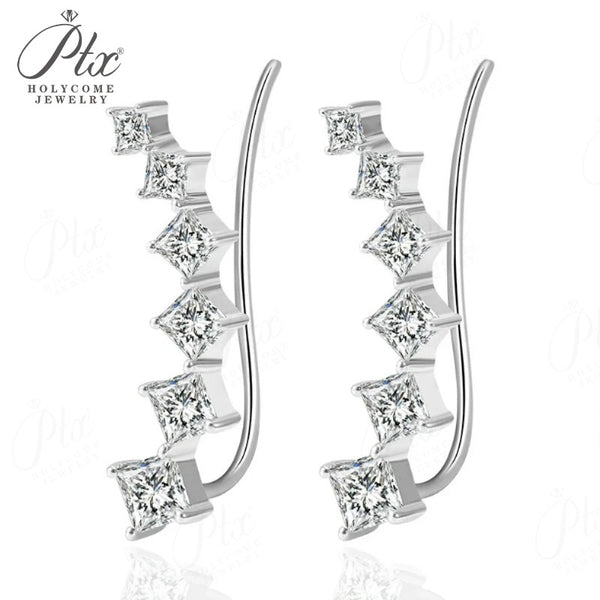
Certificates for Earrings and Necklaces: Set Jewelry
Quick answer: A moissanite earrings certificate usually covers one stone, not the pair, and that is normal rather than a shortcut. Cards and reports are issued per stone, and a pair of studs is two stones plus two settings plus a backs-and-pairing procedure that no laboratory document describes. What you should receive is one card per principal stone, plus an invoice that states the metal and the total carat weight.

Set jewellery is where paperwork stops matching expectations. A ring with one centre stone behaves like the loose stones buyers read about: one stone, one document. Earrings and necklaces behave differently, because they are assemblies — two stones that must match, or a pendant on a chain that has nothing to do with the stone's grading.
Why a moissanite earrings certificate differs from a ring's
A ring's paperwork follows its centre stone. You can photograph the stone, measure it, and check the card against it without touching the setting. A pair of studs doubles the stone count and adds a matching requirement: the two stones have to look alike in size, colour and cut, and matching is a judgement made by the person sorting the parcel, not a grade any laboratory issues.
So the document you get describes one stone. The second stone is covered by the pairing work, which lives in the seller's quality control rather than on paper. If the two look alike in the hand, the pairing worked.
One pair, two stones, one number
Our cards carry a serial number per stone. On a pair of studs that means two cards, or one card plus a note, depending on the packing run. The number identifies the stone within the parcel, and it is what you quote if one stud arrives with a chip or a colour that does not match its twin.
When you receive a pair, compare the two cards: the millimetres should match, the grades should match, and the weights should be within a few hundredths of a carat of each other. A visible mismatch in the cards usually means a mismatch in the stones, and it is easier to raise in the first week than the first year.
Why the document usually covers the centre stone
Because that is where the value and the risk sit. On a pendant, the centre stone is the piece; the bail, the chain and the clasp are metalwork. On a drop earring, the principal stone carries the visual weight and most of the cost. Documenting it is proportionate; documenting the twelve melee stones around it is not.
This is not unique to moissanite. Diamond jewellery works the same way: a halo of small diamonds is rarely itemised stone by stone, and no report lists them as individuals.
Melee: the stones nobody documents
Melee are the small stones — under about 2.5mm, cut in batches, sold by the parcel rather than the piece. They are set into halos, pavé bands, earring jackets and necklace drops. No card is issued for them individually, by us or by anyone else, because the paperwork would cost more than the stones.
What that means for you: the sparkle in a halo is not certified, and no seller can honestly claim it is. It is inspected for matching and for setting security, which is the level of assurance available at that size.
What the card actually covers on a necklace
Stone type, grade, shape, millimetres, weight and number — for the pendant's principal stone. It does not cover the chain. Chain length, link style, clasp type and metal are on the invoice and on the piece's stamp, not on the stone card.
Two things are worth checking on arrival: that the pendant's stone matches its card, and that the chain's stamp matches what you ordered. Chains get swapped between orders more often than stones do, and a 925 stamp on a chain sold as 18K is a refundable problem.
The rest of the document trail
Invoice, order confirmation and the metal stamp do more work on set jewellery than the stone card does. The invoice should state the metal and purity, the total carat weight of all stones, the principal stone's weight, and the chain length where relevant. The stamp inside the piece should agree: 925 for sterling silver, 9K, 14K or 18K for gold, PT950 for platinum.
Keep all of it together. If you ever insure the piece or have it repaired, the invoice is what an insurer or jeweller will ask for, and the card alone will not answer their questions about metal and total weight.
What to ask before buying
- Is the pair matched for size and colour, and within what tolerance?
- Does each principal stone have its own card, and can I see both numbers?
- What is the total carat weight, principal stones and melee separately?
- What metal is the chain or the earring post, and where is it stamped?
- If one stone of the pair is damaged, can it be replaced with a match?
Those five questions separate a seller who knows their stock from one who is forwarding a catalogue. None of them requires a laboratory.
What paperwork is proportionate to the price
| Category | Median price in our catalogue | Document that comes with it |
|---|---|---|
| Earrings (207 pieces) | $99.44 | GRA card for the principal stone |
| Necklaces (148 pieces) | $111.48 | GRA card for the pendant stone |
| Bracelets (48 pieces) | $122.14 | GRA card where a principal stone exists |
| Loose moissanite (117 stones) | $23.14 | GRA card per stone |
At these prices, an independent laboratory report would be a large fraction of the purchase. That is why moissanite ships with a GRA card and laboratory-grown diamond ships with an IGI report: the document is matched to the value of what it describes, not to the anxiety of the buyer.
What we do
Our earrings and necklaces are assembled in Wuzhou from moissanite we cut and sort ourselves — D colour, VVS1 by our standard — set in 925 sterling silver, 9K, 14K or 18K gold, or PT950 platinum. Each principal stone travels with a GRA card, and the invoice carries the metal, the total weight and the individual stone weights so the two documents can be read together.
If a pair arrives mismatched, or a card is missing for one of the two stones, write to sales@holycome.com with both numbers and a photograph of the two stones side by side. Matching is our job before packing, and we would rather correct it than argue about it.

FAQ
Should a moissanite earrings certificate cover both stones?
Usually not. Cards are issued per stone, so a pair should arrive with two, or with one plus a note covering the second. A single card covering a pair is a packing shortcut, not a standard.
Why is only the centre stone documented?
Because the melee stones around it are too small and too cheap to document individually. The paperwork would cost more than the stones, and no laboratory issues reports at that size.
Does the card cover the chain?
No. The card describes the stone. Chain length, metal and purity are on the invoice and on the stamp inside the clasp or tag.
How do I check a pair is properly matched?
Compare the two cards for millimetres, grade and weight, then look at the stones side by side in the same light. A visible colour difference between the two is a real problem; a few hundredths of a carat is not.
Would an IGI report be better for earrings?
Not proportionate at these prices — our earrings median at $99.44. An IGI report is what our laboratory-grown diamonds carry, where the stone's value justifies laboratory work.