Princess Cut Moissanite: The Square Brilliant Explained

The princess cut is the most efficient square cut and the most demanding one to set. Two things decide whether a stone looks right: prongs on all four corners, and a length-to-width ratio close to 1.00.
What "princess cut" actually describes
It is not a brand and not a single recipe. "Princess" covers a family of square or near-square cuts with a brilliant-style crown and a pavilion that comes to a point. Two stones sold under the name can have different facet counts, corner treatments, and light behavior.
The name only became standard in the 1980s; before that the same idea sold as a "quadrillion" or a "square radiant." No grading standard enforces what the outline should look like, which is why you check the stone rather than the label.
The structure: a square modified brilliant
Think of a four-sided pyramid. The pavilion drops from the girdle to a single point, and the crown carries a table ringed by facets that push light back up through the center.
That geometry is why princess cuts are bright: four flat planes send light down to one point and back, instead of bending it around a curved girdle. The trade-off is that those planes meet at sharp junctions, so a cutting error shows as a dark band or dead patch rather than a soft gradient.
The corners are the weak point
Four 90-degree corners with almost no thickness at the girdle. Drop the ring on tile and the corner takes the impact: moissanite resists scratching far better than it resists a sharp hit. A chipped corner cannot be polished out without recutting the stone.
Prongs belong on the corners — nowhere else
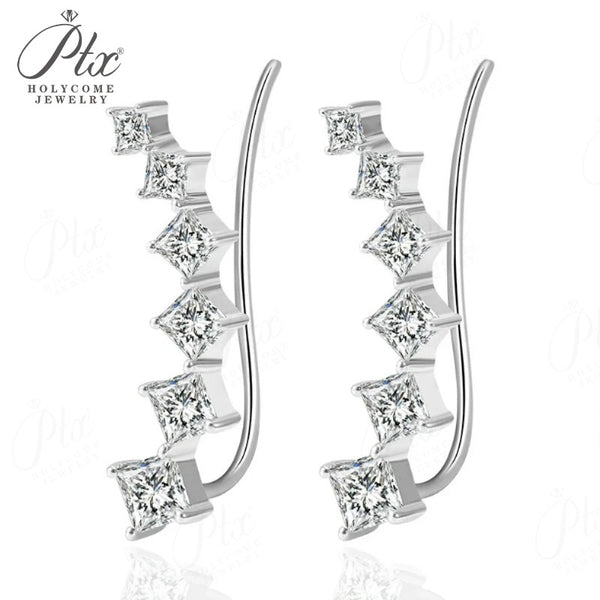
A round stone takes four prongs at 2, 4, 8 and 10 o'clock. A princess takes them at the four corners, the only place metal can wrap the vulnerable point without covering the face. Two checks:
- All four corners covered. Not three and a half. A V-prong is the correct shape; a round prong sitting on the flat leaves the tip exposed.
- Nothing over the table. A prong that creeps onto the top surface makes the stone read smaller and clips the square outline.
A bezel is the other safe answer, at the cost of some edge sharpness.
Length-to-width ratio: stay near 1.00
Most princess cuts fall between 1.00 and 1.05. Past 1.10 the stone starts reading as a rectangle and should be sold as one. Measure the stone, not the listing title — 5.50 × 5.90 mm is a 1.07 ratio, and it looks subtly oblong next to a true square in the same band.
| Ratio | What it looks like | Verdict |
| 1.00–1.03 | True square | What the name promises |
| 1.04–1.08 | Square to the eye | Acceptable on a ring |
| 1.09–1.15 | Slightly rectangular | Fine if you wanted that |
| Above 1.15 | Clearly a rectangle | Buy it as a rectangular cut |
Why it faces up smaller than a round
A princess spends more of its weight below the girdle than a round does. A 1-carat princess measures roughly 5.5 mm across; a 1-carat round measures about 6.5 mm. Same weight, about 15 percent less visible width.
That surprises people who buy by carat. If you want a princess to look like a 1-carat round, you are shopping closer to 1.4 carats. The upside is price: the weight you are not paying for is weight you cannot see.
Which hands it flatters
Square stones read architectural and suit longer fingers and narrower hands. On a short finger a large princess shortens it further: the eye reads a block, not a line.
Two adjustments: go down a size and use a thin band, or set the stone in a kite orientation so the corners create diagonals instead of a horizontal bar. A 5–6 mm princess on a 1.8 mm band is balanced on most hands.
Birefringence in a princess cut
Moissanite is doubly refractive: light entering the stone splits into two rays traveling at different speeds. On a round brilliant this shows as slightly doubled facet edges under magnification, mostly hidden by sparkle.
On a princess it is more visible, because the cut is built on long straight junctions. Tilt the stone and the crisp X of the crown softens, with a faint doubled edge along the main lines. In daylight that reads as a little extra blur in the pattern; under a 10x loupe it is obvious.
This is normal for moissanite, not a defect. At 5 mm the doubling is subtle; at 9 mm it becomes part of the look.
Checking symmetry in sixty seconds
Face the stone straight on in daylight and check four things:
- The outline. Four equal sides, four sharp corners, no bulge in the girdle.
- The center. The culet should sit under the table's center; shift your eye and it drifts if it is off.
- The pattern. Crown facets should mirror across all four sides. One denser or darker quadrant means uneven cutting.
- The tilt test. Rock it 30 degrees each way. A well-cut princess stays bright; a shallow one goes dark in the middle and shows the band beneath.
What we make
Our princess-cut moissanite is cut and set in our own factory in Wuzhou, in production since 2008. Stones are D color and VVS1 with a GRA certificate; settings are 925 silver or 9K, 14K and 18K gold, and because we control the setting too, the prongs land on the corners.
Prices run from $17 to $2,020, most pieces near $98, free shipping over $99, 30-day returns on unworn items. Between two stones, take the better corners and the truer square.