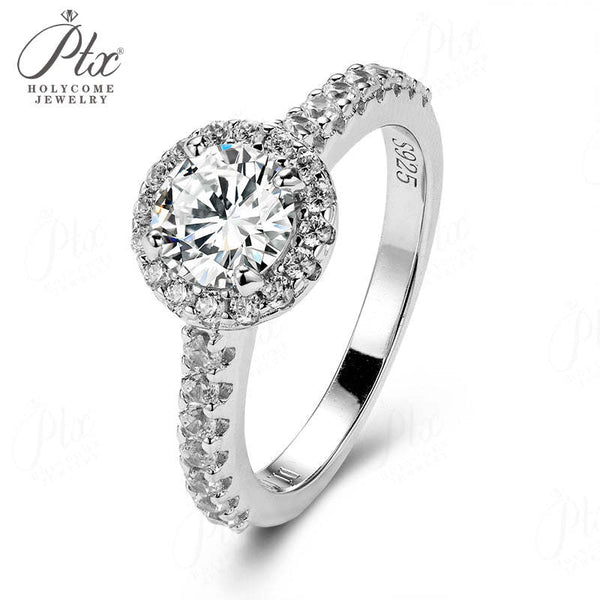
Moissanite vs Lab Diamond: The Cost Gap in Numbers

Quick answer: In an identical setting, the gap between moissanite and a lab-grown diamond lives almost entirely in the stone line. On our own site the median loose moissanite is $23.14 against a $95.42 median finished piece — the stone is roughly a quarter of the price. A lab-grown diamond replaces that quarter with the largest line on the invoice, because you pay for diamond material plus a grading report on every stone. Under about $170, moissanite buys the better finished object; above it, the choice stops being about money.
Two stones, one setting, one invoice — and only one line on it moves. Measured across 708 of our own listings.
Different materials, not different grades
Moissanite is silicon carbide, grown in a reactor. A lab-grown diamond is carbon, also grown in a reactor, by CVD or HPHT. They are not one substance at two quality levels; they are two substances cut into similar shapes.
Diamond is 10 on the Mohs scale and singly refractive. Moissanite is 9.25 and doubly refractive, which is why a large stone throws more rainbow at the edges. Neither fact explains the price gap. The gap is about what each material costs to produce and to certify.
Where the money goes in a finished piece
Every piece carries four costs: metal, bench labour, the stone, and — where applicable — grading. Metal and labour are set by the design. A six-prong solitaire in 925 silver takes the same hours whether the head holds silicon carbide or carbon.
That is the argument in one sentence. Change the stone and you change one of four lines. Change the metal from silver to platinum and you change the largest line by a factor of nearly six.
The stone is about a quarter of a moissanite piece
This is measurable from our catalogue rather than asserted. Our loose-stone median is $23.14; our median finished piece is $95.42. The stone, at retail, is a little under a quarter of the object.
The category medians agree. Rings sit at $94.49, earrings at $99.44, necklaces at $111.48, bracelets at $122.14. A ring and a bracelet differ by $28 for a great deal more metal, so what you buy as you move up our range is metal and hours, not carats.
Grading is a per-stone service
A GRA card accompanies our moissanite as a batch document. An IGI report is a different product: each stone examined, issued a numbered report, usually inscribed. That cost lands once per stone and does not shrink with the stone.
It is also why we quote lab-grown diamonds stone by stone instead of publishing a median. The polished market moves monthly, and a number printed in a blog post would be wrong within a quarter. We would rather say that than print one.
Same setting, two invoices
| Invoice line | Moissanite | Lab-grown diamond |
| Metal | Identical | Identical |
| Bench labour | Identical | Identical |
| Stone | About a quarter of retail | The largest line on the invoice |
| Grading | Batch card | Individual report, per stone |
| Replacement cost | Low; a lost stone is a small order | High; worth insuring |
| Resale | Effectively none | A real market, below retail |
Three lines are identical. The one that changes is the one buyers think about least.
What the gap is not
It is not a factor of two. The multiplier on the stone line is larger than that at most sizes, and it shrinks as lab-grown supply grows. Anyone quoting a fixed ratio is quoting history.
Nor is it "the same look for less". At 2mm and under the two are hard to separate across a table; at 8mm the double refraction is visible to a careful eye in strong light, and a jeweller will spot it in seconds. And it is not a saving you can bank: moissanite has no meaningful resale, while a graded diamond does have a market, at a discount to retail.
Which budget suits which stone
| Budget | What moissanite buys | Is a lab diamond in reach? |
| Under $66.65 bottom quartile | Small silver pieces, studs, stacking bands | No. Grading alone would dominate. |
| $66.65–$95.42 | A 0.5ct silver solitaire at $88.46, just under a 1ct at $99.18 | Not at a size anyone calls a centre stone. |
| $95.42–$169.26 upper quartile | 2ct and 3ct silver at $103.23 and $103.72, plus setting upgrades | Barely, and only by giving up size and setting. |
| $169.26–$345.80 | 14K at $183.46, 4ct at $183.50, pavé work | Yes, at modest carat weight. |
| Above $345.80 | 18K at $345.80, PT950 at $561.47, halo and hand-set work | Yes, and here the stone is the point. |
Two good reasons to pay, two to walk
Pay if you want a diamond and "nearly" will nag at you every time you look at your hand. Pay if you want the document: an IGI report is a transferable claim about a specific stone, and that matters to insurers.
Walk if what you want is size. The difference between a 1ct and a 3ct stone in our own list is $4.54 — 4.6%. Walk if resale was part of the plan, because neither stone is an investment and only one pretends to be.
FAQ
Is moissanite a fake diamond?
No. It is a different mineral sold under its own name. A fake is a simulant passed off as diamond, which describes the seller's conduct rather than the stone. Moissanite simulates diamond's appearance and is a genuine gemstone in its own right.
Does a lab-grown diamond hold its value?
It holds a market price, not a store of value. Graded stones resell below retail, and prices have fallen as production capacity has grown. Buy one because you want a diamond.
Can the two stones share a setting?
Mostly, with an adjustment. Both take standard heads, but a setter may need to open or close the prongs for moissanite's girdle. Measure the stone rather than assuming.
Is an IGI report worth the money?
On a diamond, yes — it is the difference between a claim and a document, and it travels with the stone. On moissanite a GRA card is enough; the material is consistent enough that individual certification adds little.
What we make
We have run our own factory in Guangxi since 2008, casting and finishing in 925 sterling silver, 9K, 14K and 18K gold, and PT950 platinum. Stones are GRA-certified D-colour VVS1 moissanite or IGI-certified lab-grown diamond, and we quote the diamond stone by stone because the polished market will not sit still long enough for a median. The 708 pieces we list run from $17 to $2,020, with the middle at $95.42.
Shipping is free over $99 and $5.99 below it. Returns run 30 days on unworn pieces in original packaging, which is the honest way to settle a question this visual: order the size you think you want, hold it in your own light, send it back if the stone reads wrong. We ship direct from the factory, so clearance times are outside our control.