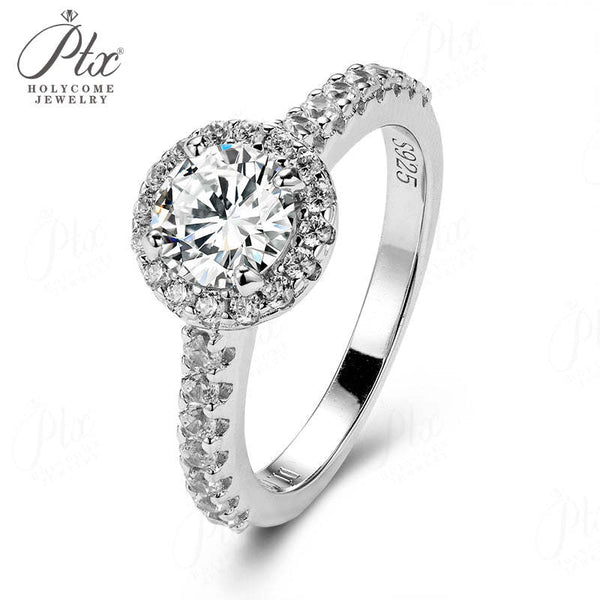
Moissanite Carat vs Size: What You Actually See

Carat is weight, not size. A 2ct marquise and a 2ct round weigh the same and look nothing alike. This is the single most useful thing to understand before buying a stone online, because listings lead with carat and your eye measures millimetres. Here is how to translate.
Why carat and size diverge
A carat is 200 milligrams. It measures mass. But mass is distributed differently depending on how the stone is cut: a deep pavilion puts more weight under the stone where you cannot see it, and a shallow one spreads the same weight across a wider face.
Two consequences follow, and both are used in the trade:
Spread. A stone cut slightly shallow has a wider face-up diameter for the same carat weight. It looks bigger and costs less per "look". The trade-off is a shallower pavilion, which returns less light and can produce a washed-out centre.
Depth. A stone cut deep has a smaller face-up diameter but more weight hidden underneath. It looks smaller than its carat suggests. This is common in coloured stones where rough is expensive and cutters maximise yield.
The number on the certificate is honest. It just does not tell you what you are actually looking at.
Round vs fancy: the size gap
A round brilliant is the most efficient shape at converting carat into visible diameter, because its outline is a circle — the maximum area for a given width.
Fancy shapes distribute the same weight over a longer, narrower outline. Roughly, at the same carat weight:
- Round — the reference. A 1ct round is about 6.5mm across.
- Oval — about 7.7 × 5.7mm at 1ct. Longer, slightly narrower. Reads larger than round because length is what the eye notices on a finger.
- Marquise — about 10 × 5mm at 1ct. Much longer. Covers more finger length than any other shape at the same weight.
- Pear — about 8.7 × 5.8mm at 1ct. Long and asymmetric.
- Emerald and asscher — about 7 × 5mm at 1ct. Step cuts, so they read smaller and flatter than brilliant cuts of the same carat.
- Cushion — about 5.9 × 5.9mm at 1ct. Slightly smaller face than round, softer outline.
- Princess — about 5.5 × 5.5mm at 1ct. Square, and reads smaller than round at the same weight because the corners are cut off.
The practical takeaway: if apparent size is the goal, an oval or marquise gives you more visible stone per carat than a round, and a step cut gives you less.
The size that actually matters: millimetres
When you compare listings, compare the diameter or the length × width, not the carat. A 1.2ct round and a 1ct round differ by about 0.3mm — barely visible and not worth a price jump. A 1ct oval and a 1ct round differ by 1.2mm in length — clearly visible.
For moissanite specifically, stones are frequently sold by millimetre size rather than carat (a "6.5mm round"), because the material is grown to size and the carat is a derived number. That is more useful to you as a buyer. Prefer the millimetre figure when it is offered.
What each size costs here
Our loose moissanite starts at $15.73 and our finished rings start at $17 for a plain band and $94 for a 1ct solitaire in silver. The pattern across the range:
- Under 1ct — the cheapest per stone, and in a halo setting reads as 1.5–2ct. Best looks per dollar in the whole catalogue.
- 1–1.5ct — the sweet spot for solitaires. Large enough to be the focus, small enough to look natural on most hands.
- 2ct and above — statement pieces. On a small hand a 2ct round can look oversized rather than elegant; on a long hand it reads proportionate.
- 3ct+ — the price climbs steeply, partly for the stone and mostly because larger stones need heavier settings and more metal to hold them safely.
Matching size to the hand
The rule most jewellers use: the stone's width should cover roughly half to two-thirds of the finger's width at the base. Beyond that it starts to look like it is wearing the hand rather than the other way around.
Short fingers: elongate. Oval, marquise, pear. Avoid wide round stones that emphasise the finger's width.
Long fingers: almost anything. Round and emerald cut proportions work particularly well because they do not add length.
Wide fingers: go larger. A 1ct on a size 9 finger looks smaller than the same stone on a size 5. This is the most common disappointment in online ring buying — the photo was taken on a smaller hand.
What to check before ordering
Ask for the millimetre dimensions, not just the carat. Any listing that only quotes carat is telling you less than it could.
Ask for a photo on a hand, or at least next to a ruler. Product photos on white backgrounds strip all sense of scale.
Check the depth percentage if the certificate provides it. 59–62.3% is the accepted ideal range for a round brilliant. Below 58% is shallow (large face, less light return); above 63% is deep (small face, weight hidden).
Remember the setting adds size. A 1ct stone in a halo presents a larger footprint than the same stone in a solitaire. If the total look is what matters, the setting is part of the calculation.
Our loose stones are listed in millimetres and carats both, graded individually, from $15.73. See loose moissanite for stones on their own, or rings to see the same sizes set. GRA certificates, 30-day returns, made in our Wuzhou workshop.